I am Prakrti Nandan, a postgraduate student with automotive industry experience, specializing in ergonomics and human factors to improve vehicle safety, performance, and user experience, applying engineering insights to design solutions that prioritize both driver well-being and operational efficiency.
Fatigue is a complex phenomenon affecting physical, cognitive, and emotional performance. In motorsport, it is a critical safety issue due to prolonged exposure to g-forces, heat, and vibration, combined with the need for intense concentration and rapid decision-making. In contrast, non-motorsport drivers experience fatigue through postural strain, repetitive pedal use, and cognitive demands such as traffic, stress, or divided attention.
This study aimed to compare how fatigue and sleepiness manifest in motorsport and non-motorsport drivers, while also examining individual factors such as BMI.
Objectives included:
Recruiting participants from both groups.
Measuring fatigue using a 1-10 numerical rating scale across body regions.
Assessing sleepiness using the Stanford Sleepiness Scale at four time points.
Comparing fatigue and recovery between groups, considering BMI.
Exploring qualitative experiences of fatigue, adaptation, external influences, technology use, and ergonomic solutions. By integrating quantitative and qualitative findings, the study sought a holistic understanding of fatigue in both elite and everyday driving.
Methodology
A comparative mixed-methods design was adopted to investigate fatigue in motorsport and non-motorsport drivers. Quantitative data provided statistical insights, while qualitative interviews captured lived experiences.
Sampling: Participants (n=12) were recruited via volunteering and snowball sampling. Motorsport participants included go-kart, GT, and drag drivers; non-motorsport drivers were mainly university students. Age was controlled (20–35 years) to minimise variability due to physical decline.
Data Collection: Conducted remotely via video calls, participants self-reported demographics and completed:
Fatigue ratings across body regions on a 1-10 scale, with derived measures such as fatigue delta.
Sleepiness ratings using the Stanford Sleepiness Scale (1-7), administered before, mid, after, and one hour post-session, allowing sleepiness trajectories to be analysed. Semi-structured interviews were piloted and refined, focusing on experiences of fatigue, coping strategies, external influences, and ergonomics.
Analysis: Quantitative data were processed in SPSS using Mann–Whitney U tests, t-tests, and subgroup analysis by BMI. Qualitative data were analysed thematically, yielding themes such as physical fatigue, cognitive strain, adaptation, and ergonomic design.
Quantitative Findings
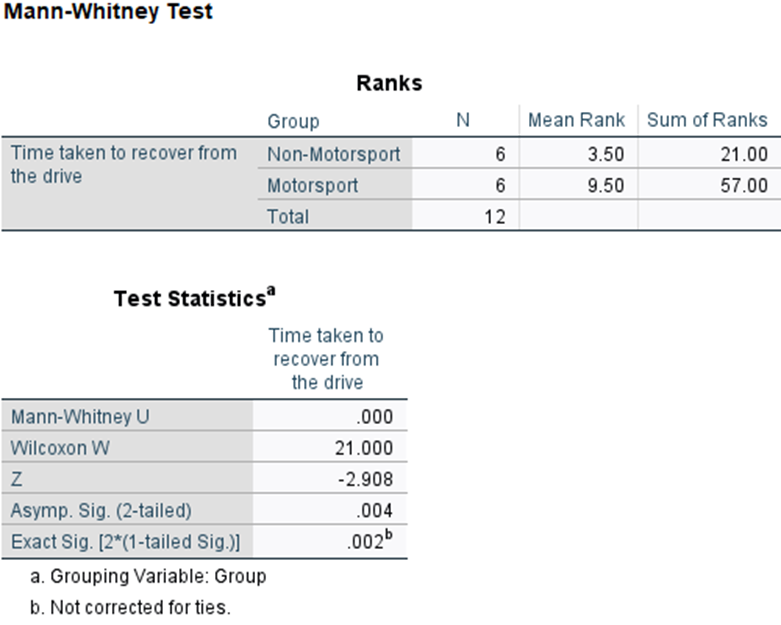
Statistical analyses revealed key differences between motorsport and non-motorsport drivers. First, recovery patterns showed a significant group effect: motorsport drivers ranked higher on post-activity sleepiness slopes, indicating they took longer to recover compared to non-motorsport drivers. This suggests that although motorsport drivers adapt to high demands, immediate post-race recovery remains challenging.
Second, body-region fatigue differed between groups. Motorsport drivers reported the highest fatigue in the lower back, arms and grip, and general body strain, reflecting musculoskeletal demands of steering under g-forces. Non-motorsport drivers, in contrast, reported localised fatigue in the neck, shoulders, and legs, consistent with postural strain and repetitive pedal use.
Finally, BMI significantly influenced fatigue outcomes. Drivers with BMI ≥ 25 reported a greater increase in fatigue post-driving compared to those with BMI < 25. This finding suggests body composition may affect moderate fatigue responses, although variability and small sample sizes require cautious interpretation.
Qualitative Findings
Thematic analysis of semi-structured interviews revealed four main themes: physical fatigue, cognitive workload, environmental factors, and ergonomic design solutions.
Physical Fatigue: Motorsport drivers emphasised whole-body strain, particularly in the back, arms, and grip, often linking it to g-forces and prolonged steering. Non-motorsport drivers described more localised discomfort, mainly in the neck, shoulders, and legs, tied to posture and repetitive pedal work.
Cognitive Workload: Motorsport participants highlighted sustained attention, rapid decision-making, and high stress under competitive conditions. Non-motorsport drivers described fatigue linked to traffic congestion, multitasking, and divided attention, such as interacting with passengers.
Environmental Factors: Heat, vibration, and noise were dominant issues in motorsport, while everyday drivers reported stress from traffic, time pressure, and external distractions.
Ergonomic Solutions: Both groups suggested improvements. Motorsport drivers focused on cockpit design, lumbar support, and hydration systems, while non-motorsport drivers mentioned seat comfort, posture, and stress management.
Together, these findings show fatigue as multifactorial, shaped by both physical and cognitive demands as well as external conditions. Motorsport drivers experience more intense, widespread strain, but many underlying mechanisms are shared with non-motorsport contexts, reinforcing the need for ergonomic interventions across both settings.
Conclusion
This study demonstrated that fatigue is a shared, yet context-specific, phenomenon across motorsport and non-motorsport drivers. Motorsport participants reported widespread musculoskeletal strain, particularly in the lower back, arms, and grip, reflecting the demands of g-forces and prolonged steering, while non-motorsport drivers experienced more localised fatigue in the neck, shoulders, and legs due to posture and pedal use. Motorsport drivers recovered more slowly post-activity, although their training likely offsets the extreme intensity they face. BMI emerged as an important factor, with higher BMI linked to greater fatigue, though small sample sizes limit certainty. Qualitative findings highlighted physical, cognitive, and environmental influences, alongside practical ergonomic suggestions. Overall, the study advances understanding of driver fatigue and underscores the importance of tailored interventions for both elite and everyday contexts.