An Industrial Engineer with extensive experience in the manufacturing industry, specializing in Human Factors and Ergonomics. Driven by a passion for understanding the interaction between humans, machines, and systems, with particular interest in transport and user experience (UX) design.
Final Project:
Evaluating the Impact of the Trainline Application on User Satisfaction and Service Quality Perception in Train Travel
Introduction
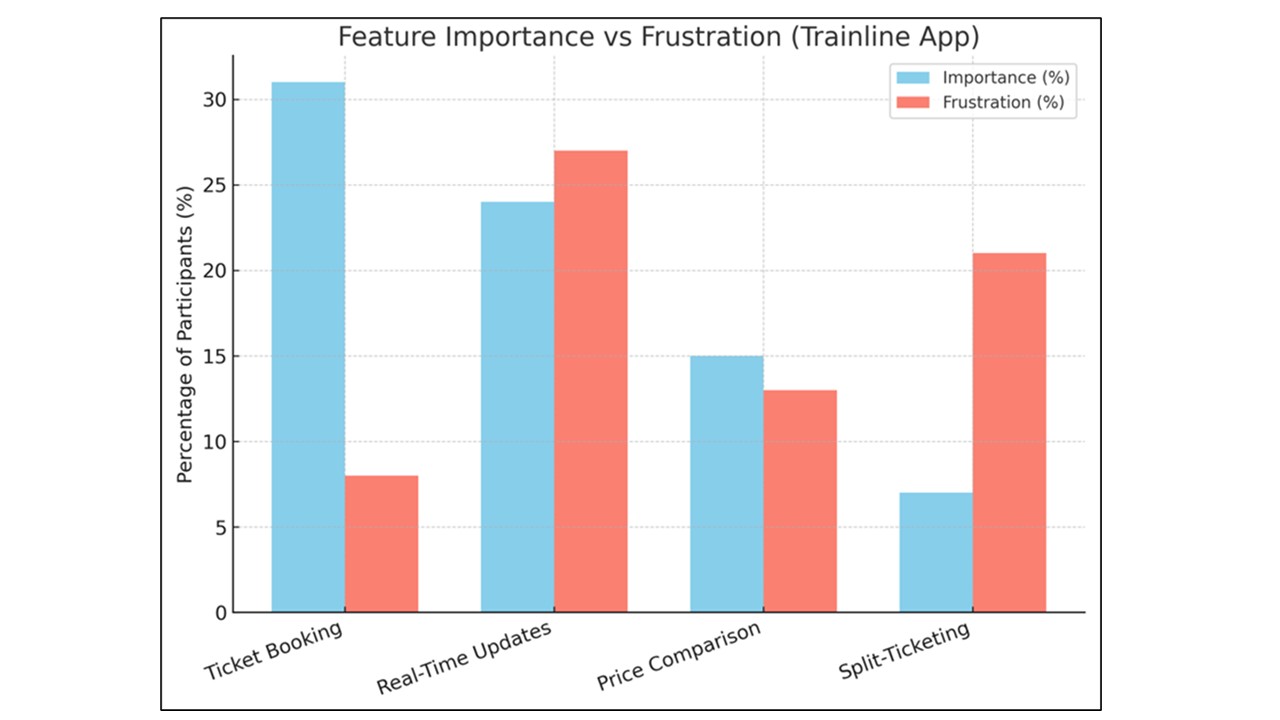
Mobile applications have transformed rail travel by simplifying the process of booking tickets and planning journey, but their usability varies depending on users’ experience level. The Trainline app dominates the UK ticketing market, accounting for over 51% of all rail ticket sales (The Armchair Trader, 2023) and more than 12 million monthly users (The Times, 2024). Despite this widespread use, critical concerns have been raised by the National Union of Rail, Maritime and Transport Workers (RMT). Their 2024 survey of 2,600 rail staff reported that over 90% had encountered passengers with invalid Trainline tickets, and 85% believed the platform often failed to provide the best-value fare. Problems such as mislabelled ticket types, unavailable refunds, and confusing split-ticketing were identified as major contributors to passenger dissatisfaction. These industry-level findings underline the importance of evaluating whether Trainline’s design genuinely meets user needs.
Research Questions:
Does User Satisfaction with the Trainline app impact user perception of train service quality?
Is there a correlation between user satisfaction with the Trainline app and the frequency of using trains?
What are the most satisfying features of the Trainline app according to users?
What improvements do users suggest to enhance the app’s usability and effectiveness?
Method
1. Online Survey
An online survey was distributed to 50 UK-based Trainline app users, aged over 18, who met the eligibility criteria. It included Likert-scale questions to measure satisfaction and perceived service quality, as well as open-ended questions for detailed feedback. The quantitative data were analysed using descriptive statistics and correlation tests (Pearson and Spearman) in SPSS.
2. Focus Group Discussion
To complement the survey, a focus group discussion (FGD) was conducted with six users of varying experience levels. The discussion explored frustrations, navigation challenges, and expectations for improvement. Thematic analysis was applied to identify recurring patterns and deeper insights, which were triangulated with the survey results.
Results
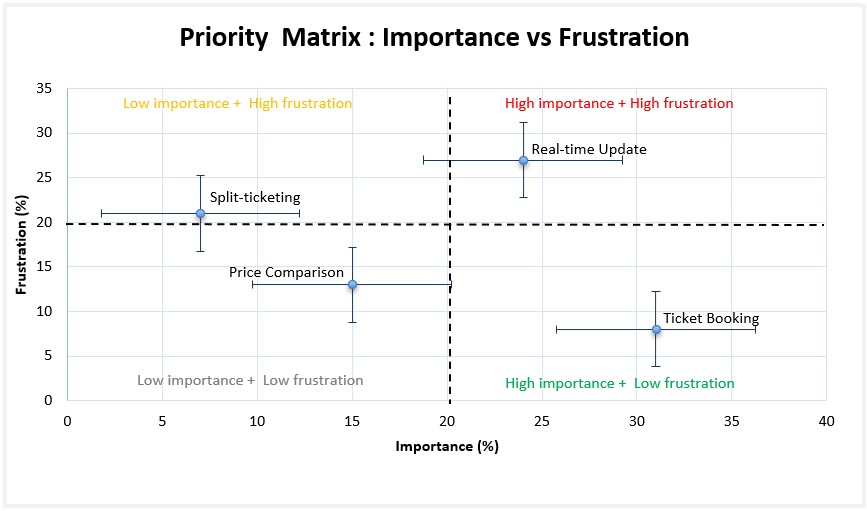
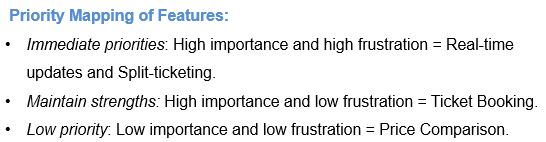
This chart plots the percentage of users who rated each feature as “very important” (X-axis) against the percentage who rated it as “very frustrating” (Y-axis). Features located in the top quadrant are categorised as high importance and frustration, making them immediate priorities for redesign. In this study, Real-time updates (importance = 24%, frustration = 27%) and Split-ticketing (importance = 7%, frustration =21%) are highlighted as their improvements could yield significant gains in overall user satisfaction of the app. The bottom-right quadrant represents high importance but low frustration, which is Ticket booking (importance = 31%, frustration =8%), indicating a key strength to maintain. Finally, Price comparison (importance = 15%, frustration =13%) is in the low priority quadrant, reflecting limited need for immediate redesign. This prioritisation framework helps to target design resources where they have the greatest impact on satisfaction and perceived service quality.
Redesign Recommendation
According to quantitative and qualitative recommendations, the improvement priority is applied to the features that hold significant importance and cause considerable frustration, specifically the Real-time update and Split-ticketing features.
New Design of Real-time Update Feature Includes: 1) Users receive information about the platform change 1 hour earlier than the actual departure 2) Step-free access details for users with disability challenges.
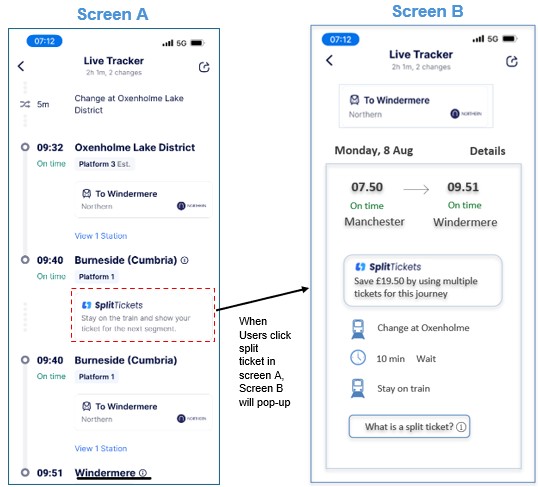
To improve the real-time update accuracy, a new design (screen B) is suggested. It is expected that users receive information about the platform change 1 hour before the actual departure, along with the step-free access details for users with disability challenges.
Screen B displays an additional interface for the split-ticketing feature. When users select the split ticket option (screen A), a new screen (screen B) will appear. Users can see the details of split-ticketing features and how split-ticketing works. The new design is expected to improve the perceived ease of use and increase the perceived usefulness (Davis, 1989), as split-ticketing holds financial benefits to users.
New Design of the Split-ticketing Feature Includes: 1) Step-by-step explanation of split-ticketing 2) Visual cues (icons for change, wait, or same train) 3) Saving displayed upfront 4) Pop-up for more information (What is a split-ticket?) 5) Lower cognitive load, reduces travel anxiety
Conclusion and Implication
These findings confirm that Trainline significantly shape perception of train service quality but has a limited impact on actual travel frequency. Although users believe that ticket booking and real-time updates are the most important features, inconsistencies in live information undermine user trust, resulting in frustration among app users. Similarly, while split ticketing offers financial advantages, it causes frustration due to the unclear understanding of its operation, which diminishes its perceived usefulness. The improvement priority gathered from quantitative and qualitative recommendations reveals that real-time update accuracy and split-ticketing clarity are the high-priority issues to improve in order to increase user travel experience. This offers an ergonomic perspective, reinforcing that usability and interface design must be analysed alongside systemic constraints such as reliability and affordability. Practically, the results suggest targeted recommendations for app developers (split-ticketing clarity), rail operators (improved timetable reliability and transparent pricing), and policy makers (support for open data and accessibility standards). Future studies should consider experimental prototypes incorporating redesigned features, comparative studies with other transport apps, and more diverse user samples.
Other Work
Interaction and Experience Design
FortiFund Application
FortiFund is a mobile banking and e-wallet prototype developed to make digital finance more intuitive, accessible, and user-friendly, particularly for individuals with limited experience in managing money or investments. The project responds to the growing challenge that, while mobile banking represents the future of financial services, many users perceive it as overly complex and struggle to see its practical benefits. FortiFund integrates ergonomic design principles to support financial literacy and confidence through three core scenarios: a Sandbox feature that allows users to practice investing in a risk-free environment; streamlined tools to allocate and release funds for everyday needs, such as supporting family members; and budget tracking with goal-setting functions to help users identify spending patterns and work towards savings objectives. By combining clarity, security, and user-centered design, FortiFund demonstrates how ergonomics and human factors can enhance trust, usability, and engagement in digital financial systems.
Sandbox Feature
Scenario 1: Michael has no experience with investing. He has been using FortiFund’s Sandbox feature, a dummy investment platform, to learn how to trade funds. His task is to move money from his dummy investment fund into his dummy current account.
Allocate and Release Funds Feature
Scenario 2 : Michael wants to give Josie some spending money, his task is to free up £20 from his saving accounts for Josie to spend on his FortiFund card.
Budget Tracker Feature
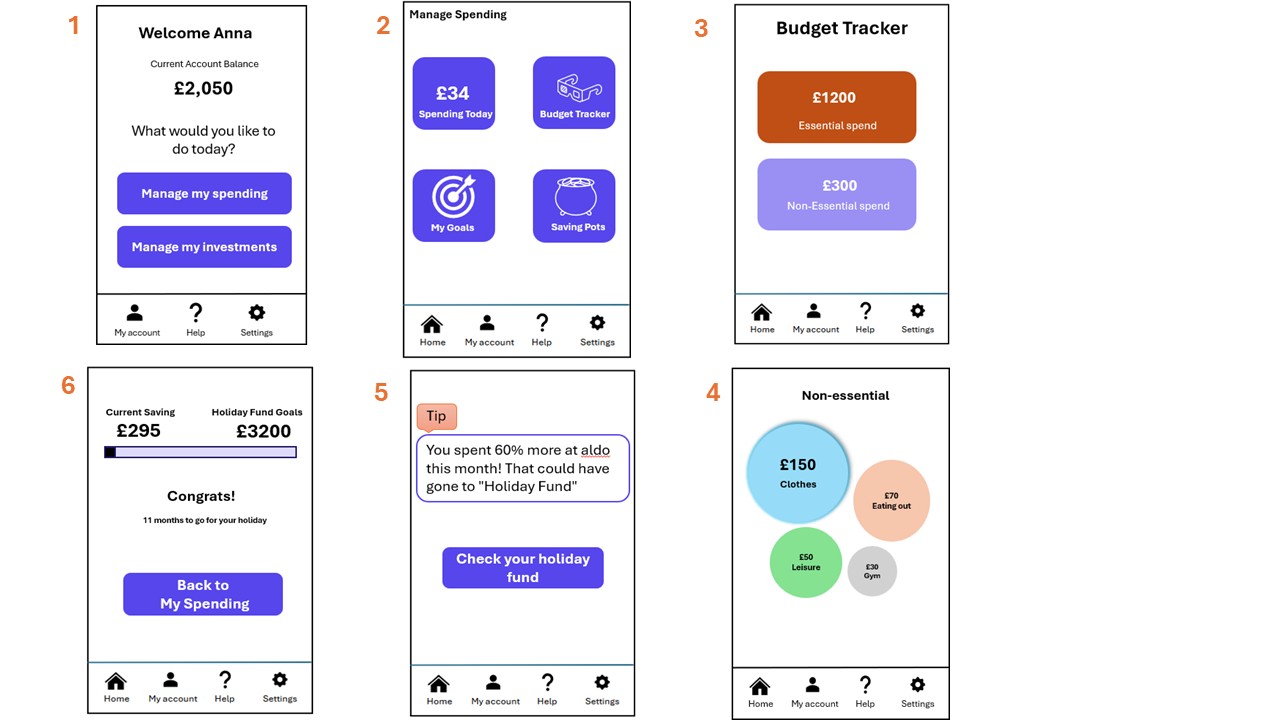
Scenario 3: Anna is planning a holiday for next summer and wants to allocate her savings to a holiday fund account, but she is unsure which non-essential items she spent the most of her budget on.
She opens FortiFund mobile banking app to check which items she spends the most on and when her holiday funding goals will be achieved.
Physical Ergonomic
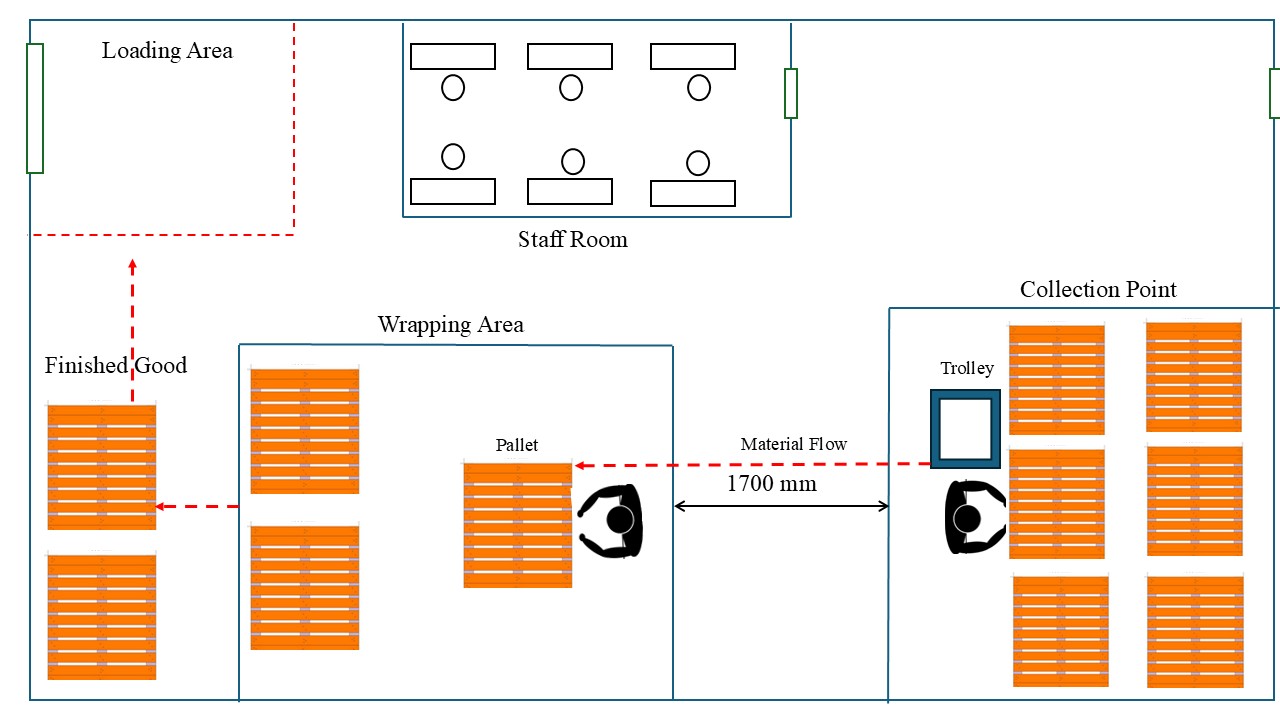
This project investigates the ergonomic challenges faced by warehouse workers during manual material handling tasks, specifically the collection, transfer, and wrapping of bobbin scrap and carton boxes. Using a comprehensive human factors approach, including postural (REBA), anatomical, physiological, biomechanical, and anthropometric analyses, the study identified significant risks of musculoskeletal disorders, fatigue, and inefficiencies linked to awkward postures, repetitive lifting, and high physical demands. The findings informed practical ergonomic recommendations, such as redesigning the warehouse layout to reduce unnecessary movement and introducing a pallet stretch-wrapping machine to eliminate high-risk manual wrapping tasks. By applying ergonomic principles to real-world industrial settings, the project demonstrates how evidence-based interventions can improve worker safety, reduce injury risks, and enhance operational productivity.