
Calvert Gerard


I am a designer shaping brands and interfaces that feel human. I mix clarity, storytelling, and strong visual thinking across identity and digital design.
I am a designer shaping brands and interfaces that feel human. I mix clarity, storytelling, and strong visual thinking across identity and digital design.


I designed the branding and UI/UX for Dhaya, a women’s safety app built on trust, speed, and compassion. The project explored how design can bridge gaps in current safety apps by focusing on quick activation, privacy, and cultural resonance.
Through research, prototyping, and visual identity development, I created a brand system and interface that feel both empathetic and reliable. Dhaya blends functional clarity with emotional strength, aiming to make safety tools more accessible and effective.


The name Dhaya was chosen with care, drawing from both Dravidian and Indo-Aryan linguistic roots to resonate across India’s diverse regions. Rooted in meanings of compassion and protection, it reflects the app’s core purpose — safety with empathy. The visual identity builds on this foundation through a monogram inspired by a sunflower, a universal symbol of light, hope, and solidarity. Drawing from the social-media myth that “when there is no sunshine, sunflowers turn to each other for light,” the mark captures the spirit of community care and mutual strength. It serves as a visual metaphor for how, in moments of fear or darkness, people can look to one another for safety and reassurance.

A clean sans-serif logotype complements the symbol, chosen for its readability, accessibility, and sense of calm authority. The warm purple and yellow palette extends this balance — purple representing dignity and empowerment, yellow signifying safety and compassion. Together, these elements form a cohesive brand system that feels empathetic, modern, and trustworthy — reflecting Dhaya’s promise of safety through shared humanity.
The development of Dhaya’s brand identity followed a user-centred, evidence-based approach. Multiple names and logo systems were tested in-app mockups to evaluate visibility, legibility, and recognition under real usage conditions. Designs were assessed for how they performed on small mobile interfaces, lock screens, and low-light environments—contexts where safety apps are most likely to be used.


Participants provided feedback on clarity, memorability, and emotional tone, helping identify which designs felt most trustworthy and reassuring. Variants that appeared overly corporate or visually cluttered were eliminated in favour of simple, high-contrast options that remained clear under stress.
The final name, Dhaya, consistently scored high for cultural resonance and emotional relatability, while the sunflower-inspired logomark proved the most effective in user testing for visibility and recall. Its soft yet confident form symbolises mutual support and compassion, embodying the app’s mission to make safety intuitive and empathetic. Building on this foundation, the UI and UX design extend the same philosophy—balancing emotional warmth with functional clarity. Every interaction, from alert activation to community features, was designed to feel immediate, trustworthy, and human-centred, turning Dhaya’s identity into a seamless, lived experience of safety.

Every feature in Dhaya’s interface was shaped through user insights and iterative testing, focusing on speed, trust, and ease of use in high-pressure situations. Each element was designed not only to function independently but to work seamlessly within an interconnected safety ecosystem.

Safe Space Mode is designed for immediate response in moments of crisis. Once activated, it instantly recognises an emergency situation and launches a full safety protocol — sending your live location to the police, your trusted contacts, and, if enabled, verified bystanders nearby. Simultaneously, it begins recording audio automatically and converts your lockscreen into a safety dashboard, giving quick access to the camera and emergency controls without unlocking your phone. To stop or exit Safe Space, users must enter a secure PIN, preventing accidental or forced deactivation. The process is built for immediacy and reliability — one action that triggers every layer of protection within seconds.

Quick Toggle builds on the foundation of Safe Space, acting as a lockscreen widget that enables one-press activation without unlocking the phone. Designed to reduce both response time and accidental triggers, it provides a controlled, reliable way to access emergency support instantly. Unlike many safety apps that risk false alarms through overly sensitive triggers, Quick Toggle uses a two-step safeguard — a deliberate press to activate and a secure PIN to deactivate. This makes it fast in a real emergency, yet resistant to unintended activation. Developed in response to user reviews highlighting frequent accidental alerts in other apps, Quick Toggle ensures that help is always one press away — but only when truly needed.

The Bestie List works hand in hand with Safe Space, creating a bridge between emergency response and everyday reassurance. When Safe Space is activated, your Bestie contacts are instantly notified—receiving your live location, status, and updates in real time. This integration means help isn’t limited to authorities; it comes from people you trust most. Unlike built-in phone safety features that stop at emergency alerts, Dhaya builds a connected network of care, making it more personal, responsive, and reliable when every second counts.
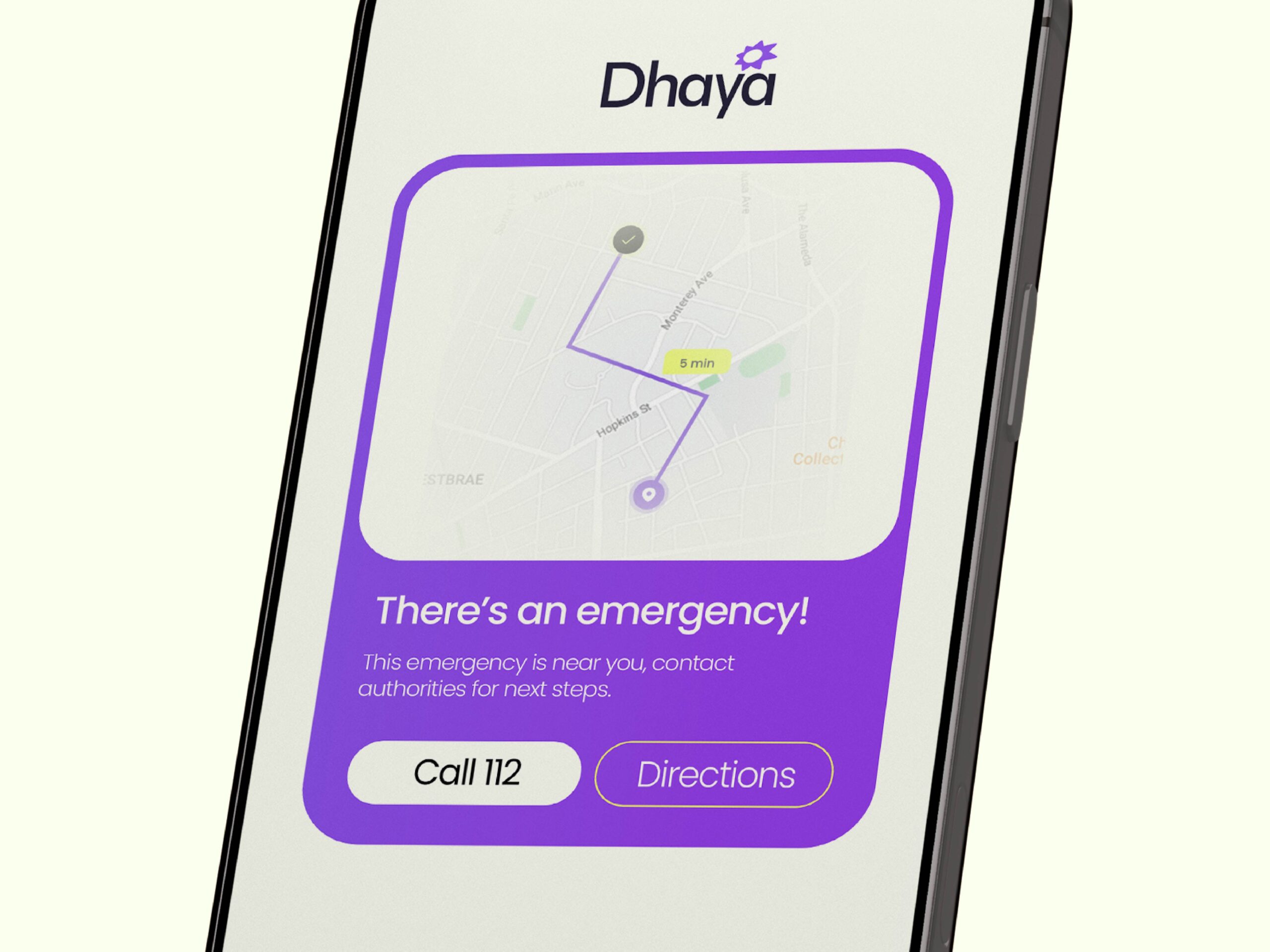
Bystander Assist addresses one of the most challenging findings of the research—women’s mistrust of strangers during emergencies. This feature is accessible only to verified users who complete a short in-app training module on safe intervention. Once verified, these trained bystanders can receive alerts when someone nearby activates Safe Space and choose to assist responsibly. By combining ID verification with guided readiness, Bystander Assist creates a layer of trusted community response, ensuring help comes only from accountable, prepared individuals rather than random passersby.
Together, these features form a safety system built on empathy, speed, and trust. By merging rapid response with verified community support, Dhaya redefines what safety technology can be—proactive, human, and reassuring. It empowers users to feel protected not just by their devices, but by the people around them.