I'm a user experience designer with a background in visual communication, specialising in user research, behaviour change and critical thinking. I focus on creating intuitive user-centred experiences that help people develop healthier habits and interact meaningfully with technology.
PAWSE – Your time, your choice, your pawse
A digital health app that helps users reduce their addiction to short videos and develop healthier video watching habits through gentle reminders rather than forced restrictions, combined with gamified tasks and a cute mascot to keep them company.
Background
According to the double diamond model, in the design the right thing section I looked around my own life and realised that in recent years the influence of short videos on our lives has become very deep, however users are not aware of the physiological effects of watching short videos for a long time. The overall design of short videos and social media platforms can get users hooked, it may solve their entertainment or social needs, but it also hides the impact it has on their concentration, sleep etc.
User pain point
After interviewing 8 participants across two age groups and analyzing the data using Affinity maps, quantitative research and value axes, I eventually identified the key pain point: users generally felt they shouldn’t spend too much time on short-form video, but self-control and existing apps which are used to block apps often don’t achieve long-term behavioral change.
1-hour interviews with participants
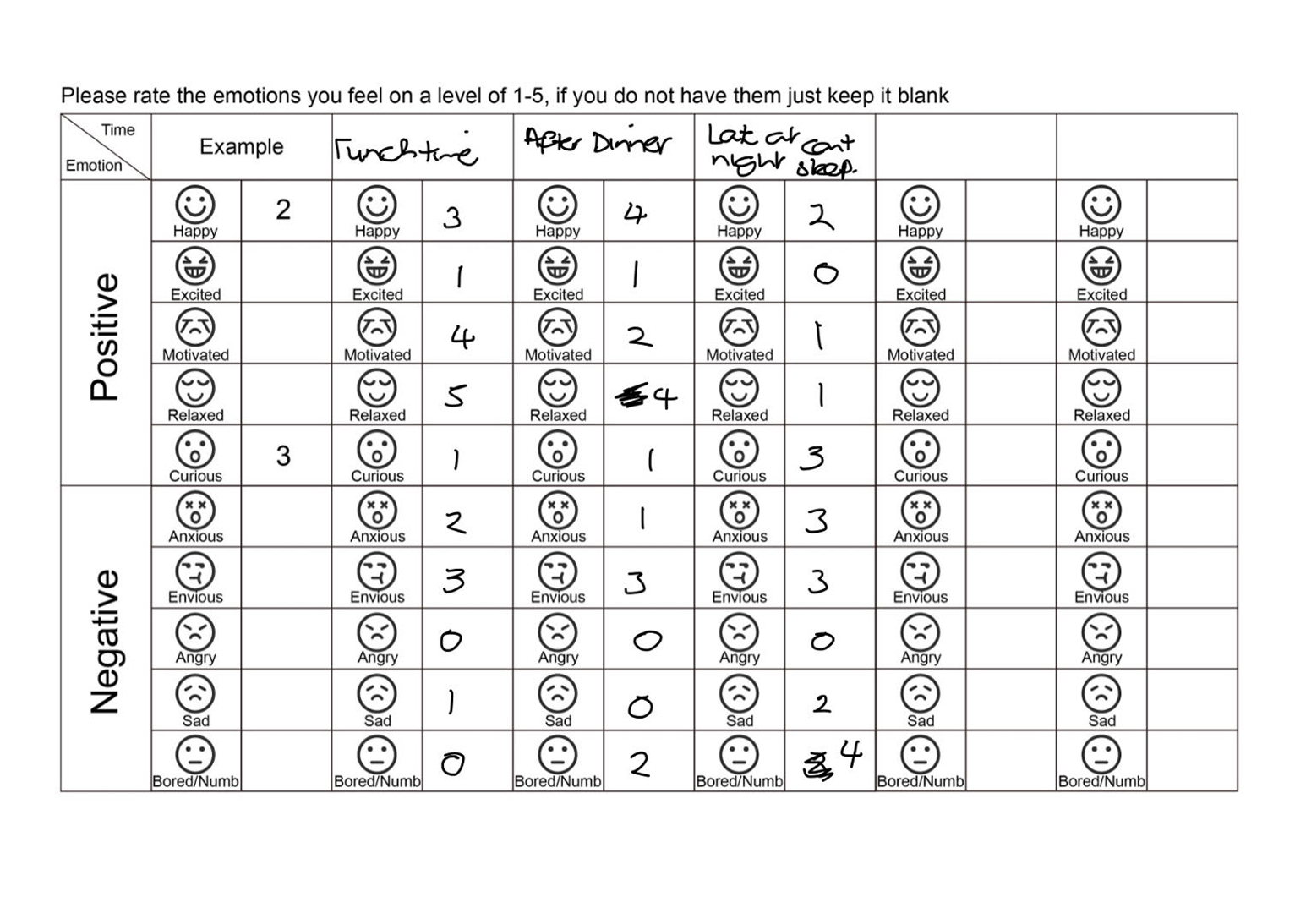
Quantitative research to collect emotional status when watching short videos in different scenarios
Analysing Primary Data with Affinity Mapping
Design vision statement & Principles
This insight shaped my design vision: to help long-time short video users notice their habits and gradually reduce consumption—without removing the sense of enjoyment or relaxation they seek. Based on the vision statement, combined with the stage of change model and the pain point analysis of the target user group, I summarized three design principles: Support Self-Awareness, New habits replace old ones and Redirect not Restrict.
Outcome & Iteration
Through continuous user interviews, secondary research, and design theory, I developed the concept of PAWSE by analyzing idea suitability with the HNW matrix and mapping it to the stages of change model. I then created personas, storyboards, and journey maps to capture detailed user pain points and opportunities, before designing user flows and prototypes. Through multiple rounds of participant testing, I refined features such as digital pets, gamified rewards, social feedback, and user interface details. Following iterative usability testing, the final concept of PAWSE emerged—a digital health app that helps users reduce their obsession with short videos through gentle reminders, engaging tasks, and long-term habit formation.
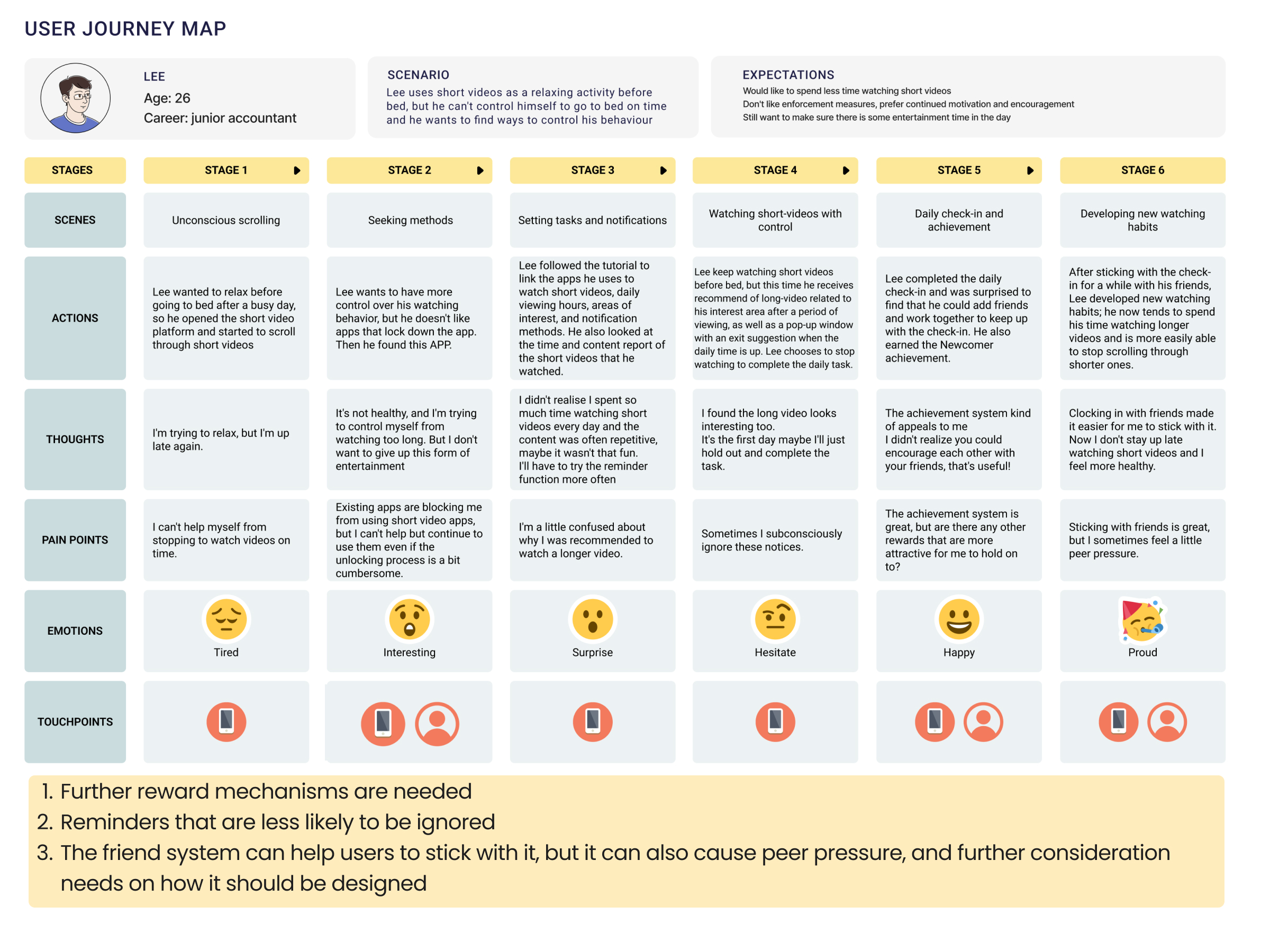
User journey map
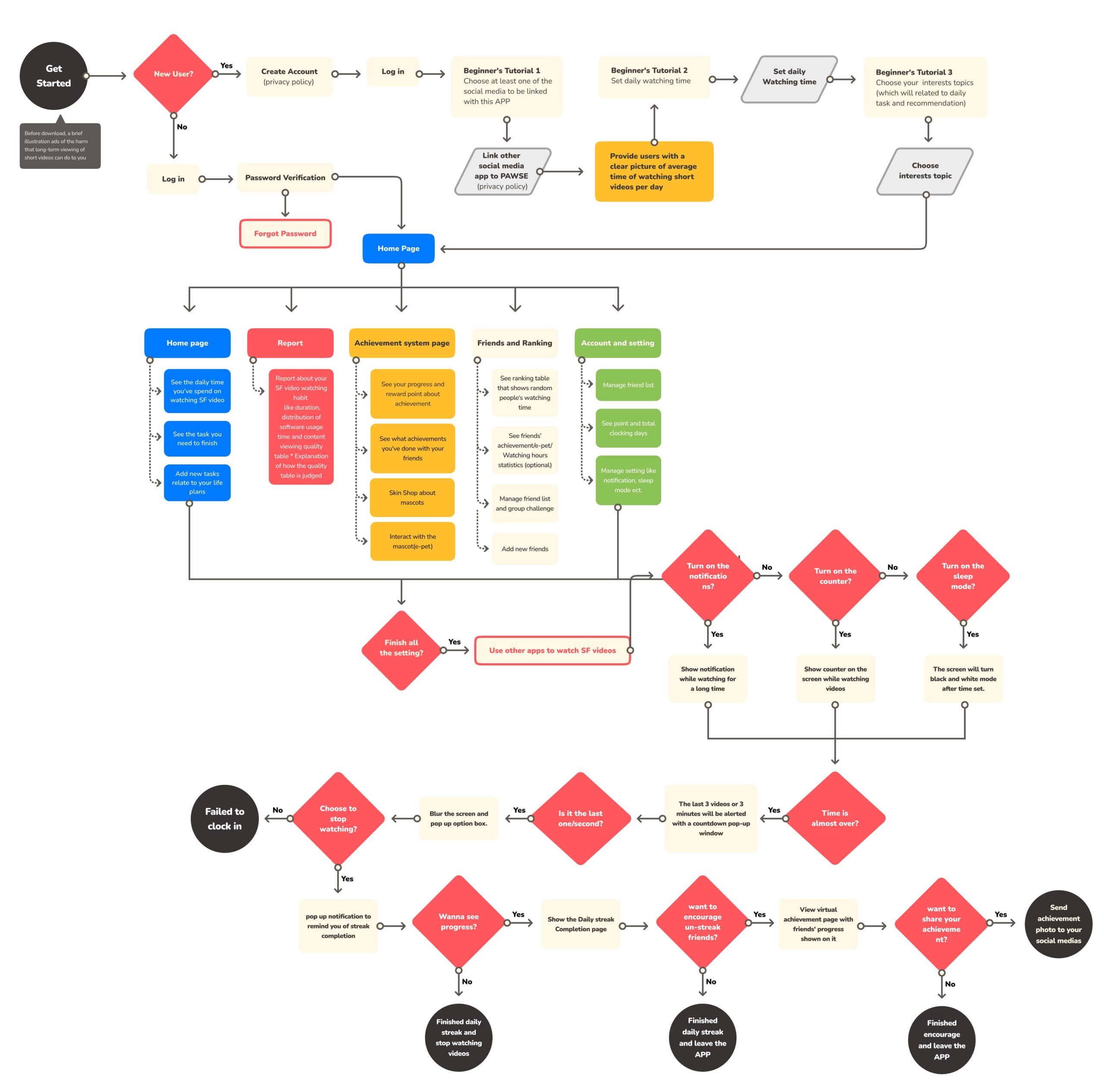
User flow
Main Functions
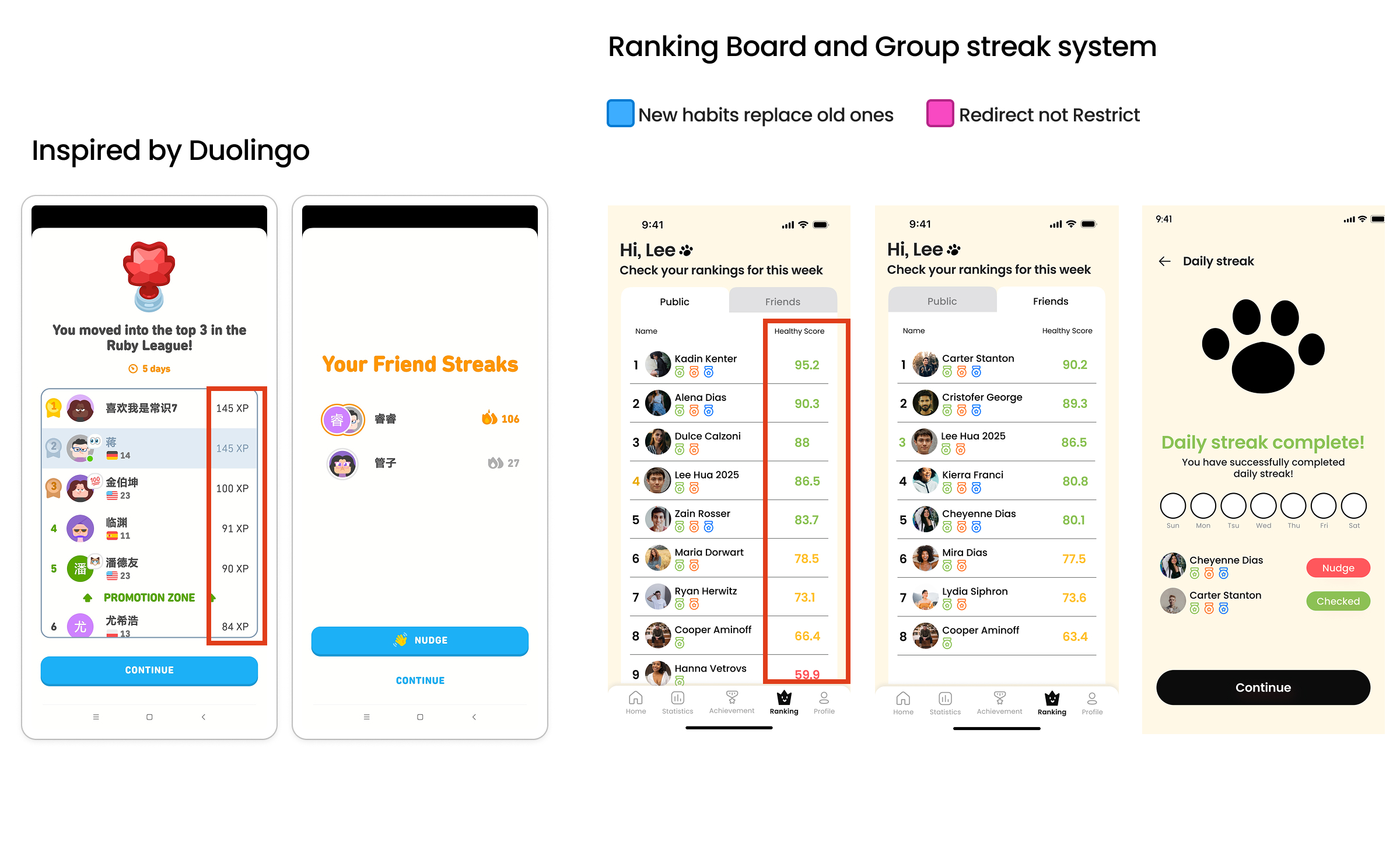
Ranking Board and Group streak system
Ranking Board and Group streak system
Learning from Duolingo’s approach, PAWSE introduces leaderboards and group streaks to enhance learning motivation and peer relationships. To avoid negative peer pressure, rankings are split into public and friend rankings and are based on AI calculated balanced health scores rather than watching times, creating a healthier, encouraging form of social comparison.
Achievement system & E-Pet
Gamification rewards and E-Pet companions encourage long-term user engagement through consistent positive feedback. Over time, users are guided to form healthier viewing habits, while virtual pets reduce feelings of loneliness during the transition and provide a relaxing, supportive way to spend time instead of watching short videos.
Achievement system & E-Pet
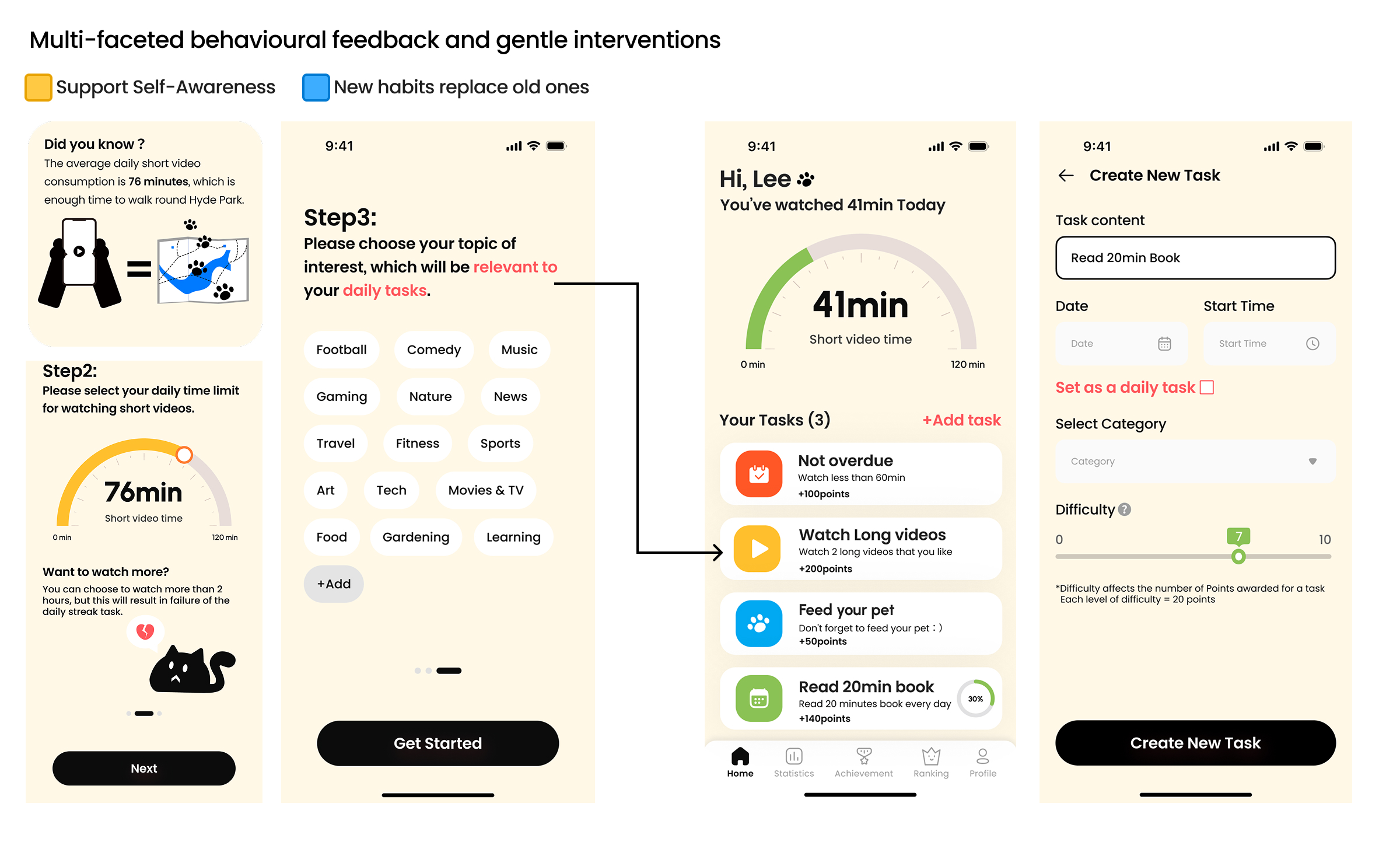
Multi-faceted behavioral feedback
Multi-faceted behavioral feedback
With personalized reports such as video ‘nutritional’ analysis, ranking and achievement tracking, PAWSE helps users understand the results of their behavioral change in a real-time, intuitive way. Customized goals and peer streaks function help transform individual progress into a shared experience, further increasing the positive motivation of users who expect to perform well in group motivation.
Gentle interventions
Instead of enforced restrictions, PAWSE uses subtle cues such as personalized pop-ups, nutritional warnings and vague reminders. A unique three-step countdown prevents users from subconsciously ignoring interventions, while encouragement based on daily streaks transforms small actions into a continuous cycle of positive change.
Multi-faceted behavioral feedback and gentle interventions
Future statement
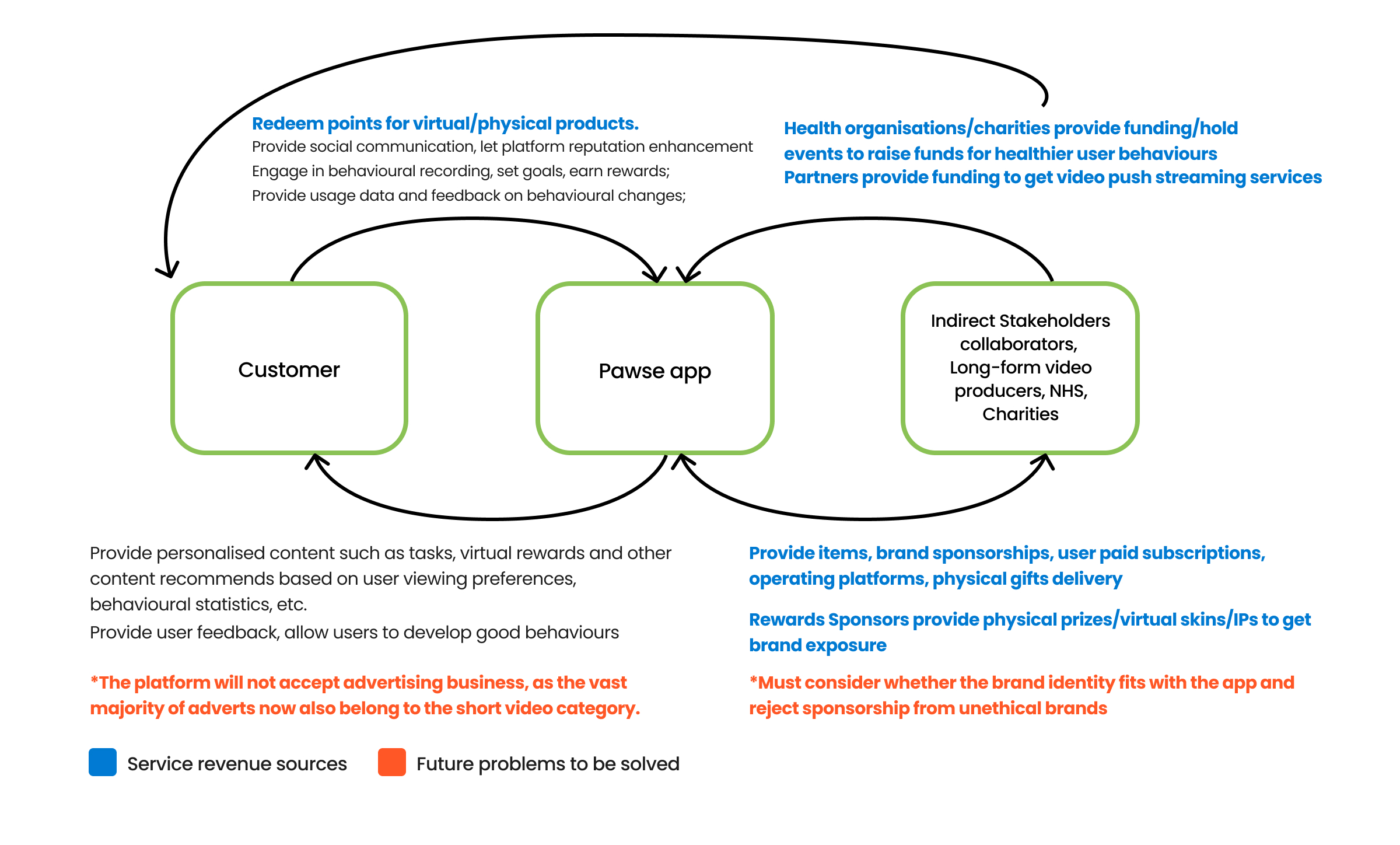
After the UI issues were resolved, the addition of achievements and E-Pet highlighted that the earlier design had overlooked the broader business structure of the app. This was analyzed using a stakeholder map. At the centre are the users, who receive rewards for logging behaviors, completing tasks, and providing feedback data. The middle layer is the PAWSE app, which provides personalized tasks and social stimulation while connecting to internal resources. The outer layer includes indirect stakeholders such as brand sponsors, long-form video producers, and health organizations, who promote healthier behaviors by offering rewards, funding, or event support. Overall, PAWSE establishes a user-centred motivational ecosystem that links individual habit change with wider stakeholder engagement.
Stakeholder map
Short-form video is here to stay – the real challenge is learning how to use it in a healthier, more sustainable way, and PAWSE represents my answer to that challenge: user-centred design that empowers people to regain control, develop positive habits, and turn moments of distraction into opportunities for growth.