I strive to blend research, problem-solving, and stunning visuals to craft immersive experiences that feel intuitive, seamless, and almost otherworldly.
How might we support physiotherapy patients—especially those recovering independently—to stay consistent, motivated, and confident throughout their rehabilitation journey using digital tools that are both immersive and intuitive?
Project Brief
Rehabilitation often loses momentum once patients leave the clinical environment. Motivation drops, progress becomes unclear, and exercises are often forgotten or poorly performed (Jack et al., 2010). This project set out to reimagine the physiotherapy experience at home by exploring how a hybrid digital system – combining mobile interaction with immersive VR – can:
Provide daily structure and clear feedback
Encourage engagement through immersive VR movement
Support emotional and physical progress monitoring
By grounding the solution in both behavioural psychology and immersive interaction design, this project aimed to bridge the gap between clinician-supervised therapy and self-managed rehabilitation (Yardley et al., 2015; Davis, 1989).
The Solution
Elevo is a hybrid rehabilitation system that merges the flexibility of mobile UX with the immersive power of VR, designed to improve adherence, personalization, and motivation in home-based physiotherapy.
While existing tools focus either on mobile or VR independently, Elevo combines them into one seamless ecosystem that supports the entire recovery journey — from planning and personalisation to progress tracking and immersive execution.
The Process
The design journey for Elevo followed the Double Diamond UX process: Discover → Define → Develop → Deliver. It included mixed-method research, behavioural analysis, wireframing, and immersive prototyping using Figma and ShapesXR, leading to a fully evaluated hybrid rehabilitation system.
01 – Discover
Understanding the problem, the users, and the context of physiotherapy at home
Literature Review: Explored behavioural psychology, rehab adherence, VR in healthcare, and mobile tracking solutions (Yardley et al., 2015; WHO, 2021)..
Identified Gaps: Low adherence in home-based physio, lack of feedback, disengagement, and poor VR portability.
Tools Used: Google Scholar, ResearchGate, Mendeley, ChatGPT.
Output:
Final Research Aim, Objectives, and Research Questions
Well-defined methodology for data collection (interviews, surveys)
02 – Define
Synthesising data into user insights and framing the design direction
Semi-structured interviews with physiotherapy patients and physio students
Affinity mapping &priority matrix to extract themes and user pain points
Personas developed to represent primary user needs
UX Vision Statement: “There is an opportunity for a hybrid mobile-VR technology for rehabilitating patients and their physiotherapists who want to maintain motivation, track progress, and deliver or receive personalised physiotherapy beyond clinical settings by providing an intuitive hybrid system combining mobile tracking and immersive VR guidance, with shared feedback loops and adaptive experiences that bridge the gap between clinic and home”
Clear design principles and scope for the prototype
Prioritised core features for mobile + VR
03 – Develop
Translating insights into structure, wireframes, and immersive interactions
User Journey Mapping for typical rehab experience (before → during → after)
Information Architecture
Mobile App-
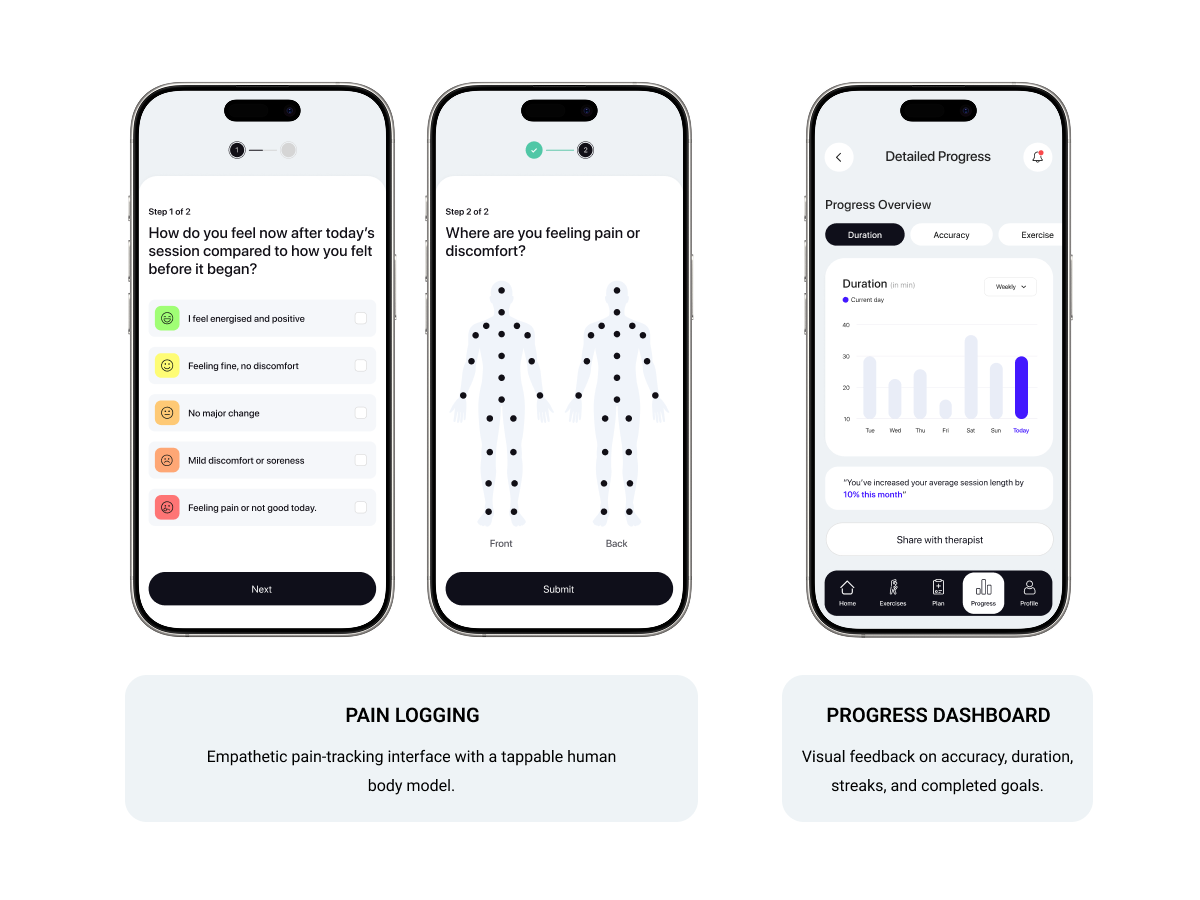
The app is organised into five main sections: Dashboard, Exercises, Progress, Mood & Pain Logging, and Rewards. Users start with onboarding, then navigate daily goals, explore personalised playlists, track mood/pain, and view progress insights.
VR-
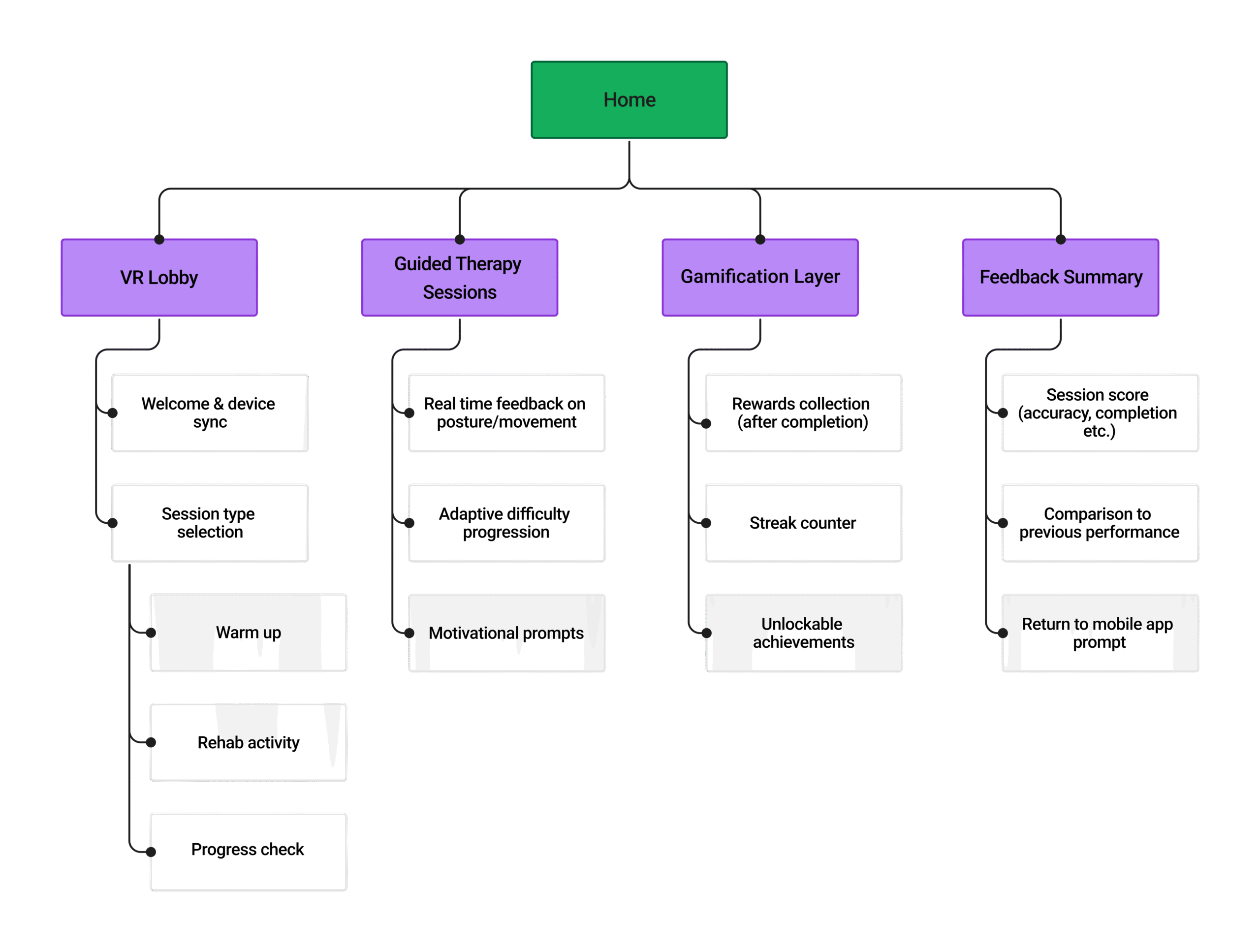
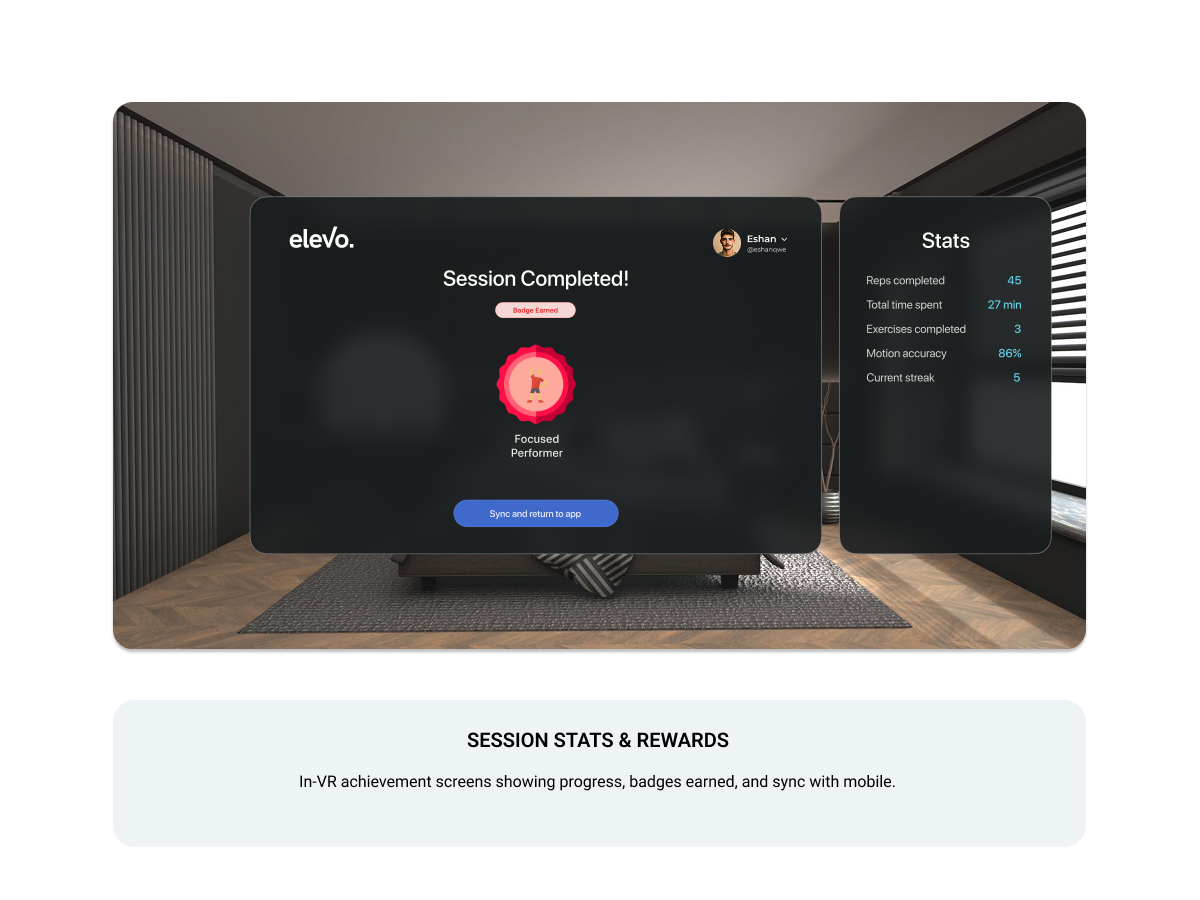
The VR experience is designed around a simple flow: Session Selection → Warm-Up → Main Exercise → Live Feedback → Completion Summary. Navigation is minimal to reduce cognitive load and ensure immersion.
User Flow
Lo-fi Wireframes for onboarding, home screen, pain logging, therapy plans
Moodboarding & Design System (colors, typography, iconography)
A/B Testing Prep: Prototype A (existing app baseline) vs. Prototype B (Elevo improved version)
04 – Deliver
High-fidelity prototypes, VR scenes, evaluation and iteration
Hi-fi Designs built in Figma
VR Prototype developed in ShapesXR
Mobile Experience
VR Experience
Usability Testing (lo-fi and hi-fi stages)
Online Survey with embedded SUS (Brooke, 1996), UES (O’Brien et al., 2018), and perceived effectiveness questions
Statistical Evaluation using SPSS:
SUS (Usability) — scored 80.63 (vs 60.75 in baseline)
The development and evaluation of Elevo demonstrated the potential of combining mobile and VR platforms to support long-term physiotherapy adherence. The final prototype received strong usability and engagement scores, with users highlighting the intuitive interface, immersive VR experience, and motivating progress feedback as key strengths. Testing showed a significant improvement in perceived effectiveness compared to existing solutions.
This project deepened my understanding of behavior-driven design, mixed-method evaluation, and cross-platform interaction. It also taught me how to design immersive experiences that feel meaningful without overwhelming the user. If continued, I would explore deeper therapist integration and real-time feedback loops to further enhance remote care.