


Industrial Designer by training, UX Designer by practice. I am passionate about exploring next-generation interactions, from tangible products to immersive VR.
Industrial Designer by training, UX Designer by practice. I am passionate about exploring next-generation interactions, from tangible products to immersive VR.


This project investigates the central design challenge in Virtual Reality (VR) furniture shopping: should the experience feel like an immersive showroom, or function like an efficient website? To answer this, I designed and built two distinct VR prototypes—an “Exploratory” model for discovery and an “Interface-based” model for task completion—following a rigorous, user-centred design process.
(i) What is the effect the two modes on the perceived usability of the VR furniture shopping environment?
(ii) How does user engagement differ when using two modes?
(iii) How is the distribution of users’ visual attention affected when navigating via two modes?
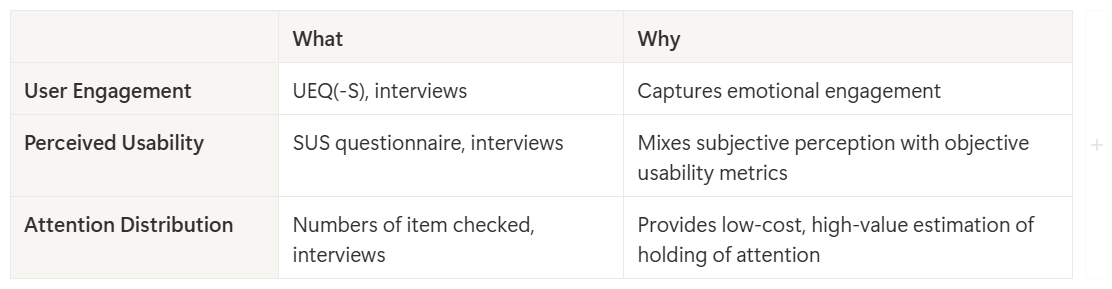
We conducted a formal user study with 30 participants, who were tasked with shopping in one of the two VR environments. Their mission was to dicover their favorite sofa which they believe best fit their virtual room.


o Interaction:Rather than navigating a physical space, the user interacts directly with this UI panel.
o Fixed player position
o Catalogue interaction
o Simple UI elements
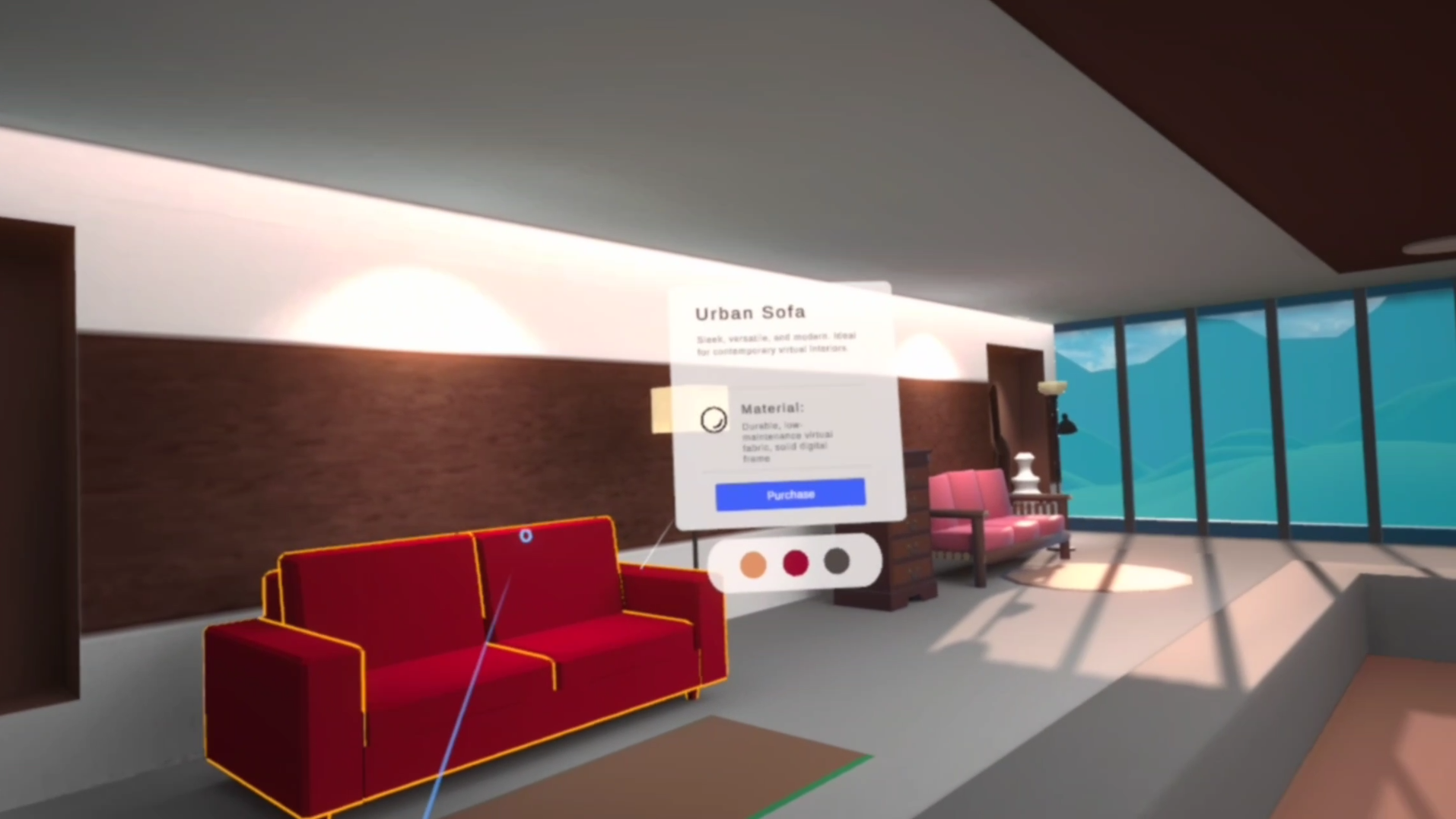
o Interaction: Users can navigate the space freely using a teleportation mechanic. They can approach any piece of furniture from any
angle, allowing for a detailed inspection.
o Enable moving
o Wide & open space for exploration
o Decors & lighting

On the surface, our quantitative results showed a state of equilibrium. When we compared the two prototypes using the User Experience Questionnaire (UEQ) and the System Usability Scale (SUS), there were no statistically significant differences between the Exploratory and Interface-based models. Participants rated both systems comparably in terms of overall experience and ease of use, suggesting that neither was objectively “better” than the other from a purely numerical standpoint.
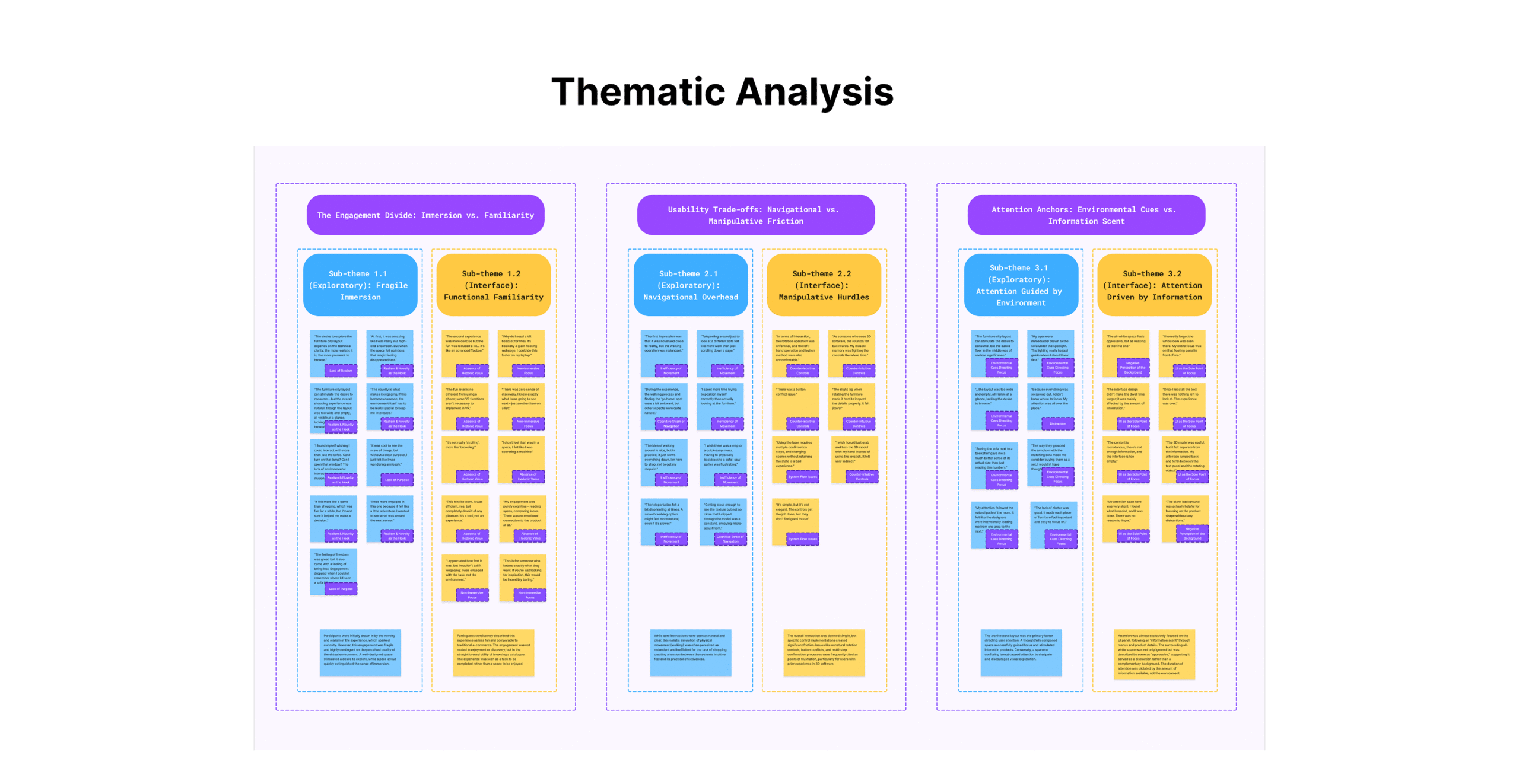
However, the real insights emerged from our qualitative analysis. The interviews made it clear that while the scores were similar, the nature of the experience was worlds apart. We identified a clear “Engagement Divide” and significant “Usability Trade-offs.”