
Freya Durrant


Patient safety specialist and speech and language therapist, with a background in leadership.
Currently a national patient safety investigator with the HSSIB.
Patient safety specialist and speech and language therapist, with a background in leadership.
Currently a national patient safety investigator with the HSSIB.
What systemic factors impact implementation of HSSIB recommendations?
The Health Services Safety Investigations Body (HSSIB) is a fully independent arms-length body of the Department of Health and Social Care. They are tasked with investigating patient safety concerns across the NHS in England, and are one of the only examples of such organisations in the world. As such, their output has no blueprint.
The HSSIB have been operational since 2017, and since that time have undertaken numerous national patient safety investigations. Each investigation contains recommendations that are aimed at national bodies to affect system-wide change.
As yet, there has been no formal attempt to quantify the impact that the HSSIB has had on the healthcare system, something that is increasingly needed as national patient safety functions come under governmental scrutiny. This project aimed to kickstart this attempt, by analysing the implementation of HSSIB recommendations, and beginning the work to understand what factors may influence implementation; the necessary first step in assessing impact.
Step One:
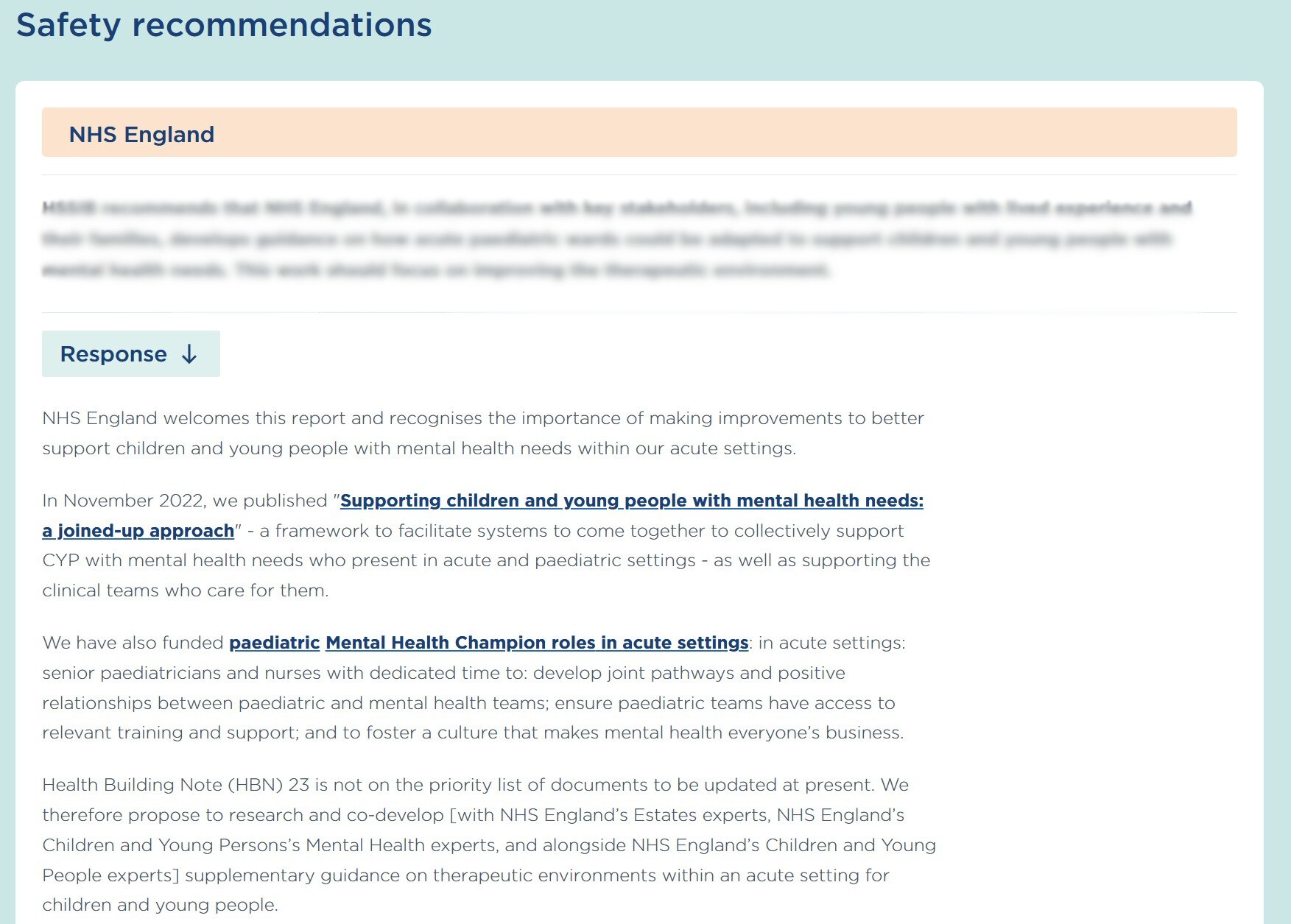
Thematic Review of HSSIB Recommendations & Associated Responses
In total, 283 HSSIB safety recommendations were included within the thematic review. Recommendations were issued between November 2018 and May 2025.
All recommendations and their associated responses were taken from publicly available patient safety investigation reports found on the HSSIB website.
Step Two:
Interview Representatives from National Bodies
Participants were employed by national bodies responsible for implementation of HSSIB recommendations, and included;
1) NHS England
2) National Institute for Clinical Excellence (NICE)
3) Royal College of Paramedics (RCP)
4) British Society of Gastrointestinal
and Abdominal Radiology (BSGAR)
5) Care Quality Commission (CQC)
All were responsible, in some way, for the implementation of recommendations within their organisation.


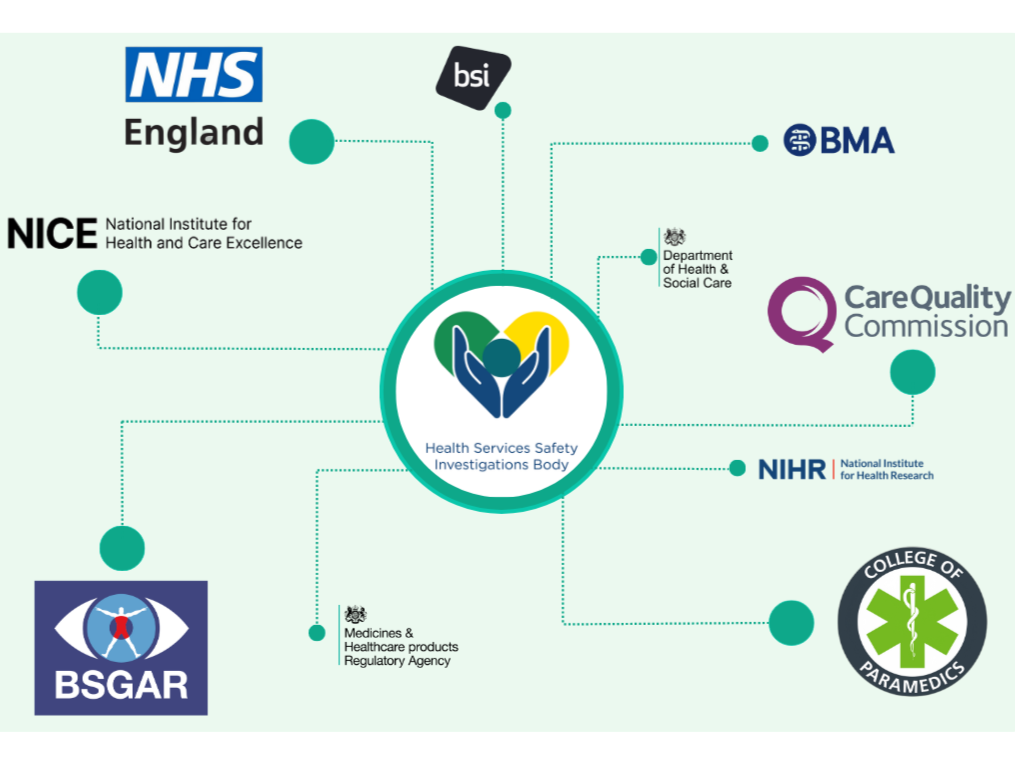
Representatives from five national bodies were interviewed to provide further insight
into factors that influence implementation of HSSIB safety recommendations.
Interviews were recorded and transcribed, and transcripts were subsequently
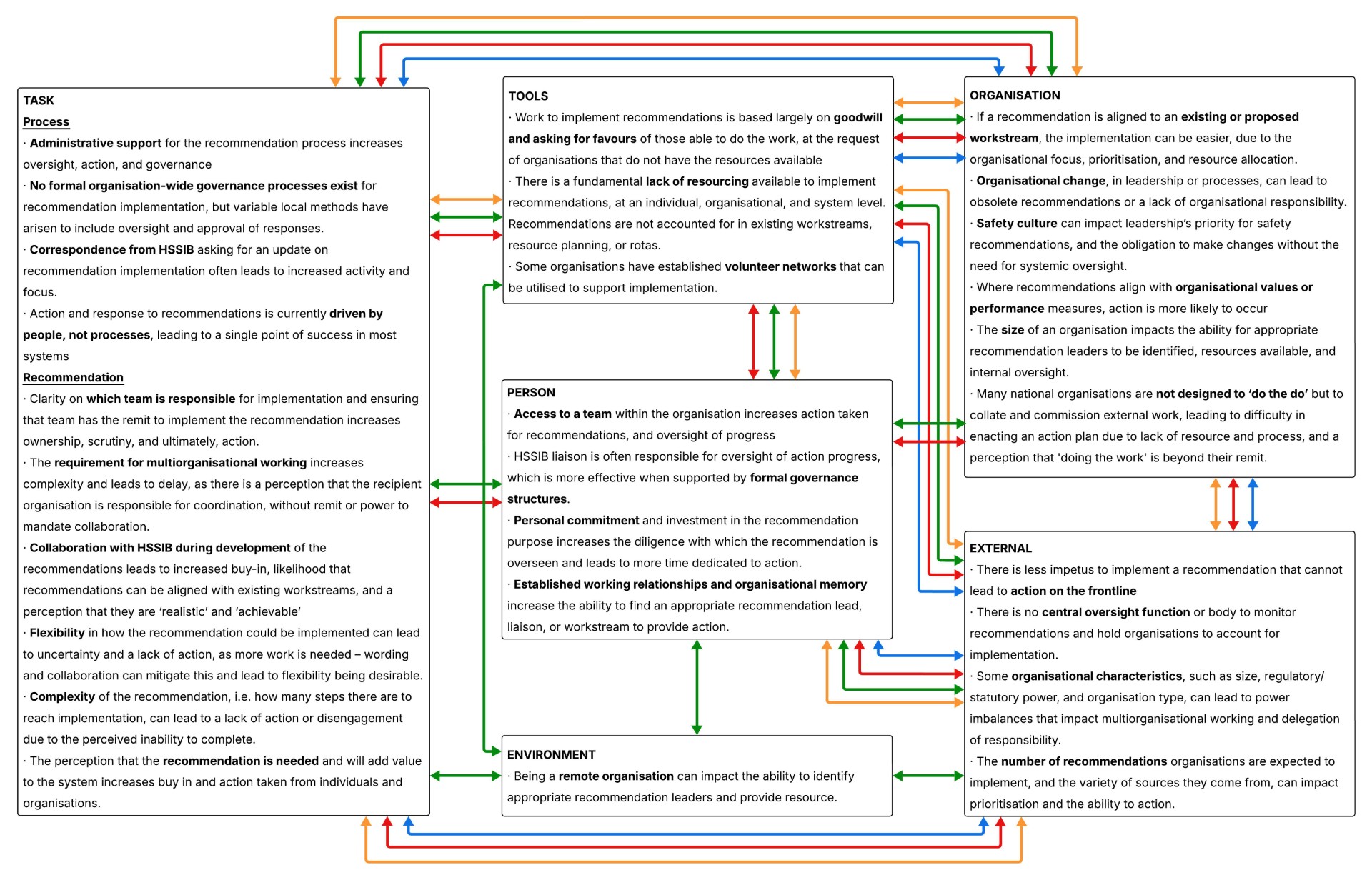
analysed to identify and explore systemic factors using the SEIPS 2.0 work system.
Key interactions arising from the analysis included:
– Recommendation implementation is challenged by the identification and
allocation of resources.
– Current methods for recommendation implementation are driven by people,
not processes.
– A lack of systemic oversight impacts sustained focus afforded to
recommendation sufficient to achieve implementation.
– Scoping and implementation planning is not sufficiently transparent or robust
to guide combined action.
Systems Engineering Initiative for Patient Safety [SEIPS] HSSIB Recommendation Implementation Work System
The study was limited by time and resource, and so future research would be
beneficial to focus upon understanding the ‘true’ status of recommendations
implementation, interrogating the hazard controls recommended by HSSIB, and
building upon the work system of recommendation implementation with ways in
which challenges can be overcome.
The lack of data available to analyse the implementation status of HSSIB
recommendations is reflective of a problem highlighted within analysis of the work
system; there is no system oversight of recommendation implementation. The study
found that a request for an update at 90 days is the only systemic oversight that
organisations receive for the process of implementing recommendations. This makes
it challenging to maintain organisational focus to implement recommendations that
are lengthy and require resource.
The study found that resource constraints are the most prevalent challenge for
HSSIB recommendation implementation, as national bodies are often not designed
to ‘do the do’. National bodies are not able to redirect resources from other
workstreams as money is allocated to specific work, and in the current economic
climate, resources for existing workstreams have no additional capacity. Without
costing or economic justification for changes, national bodies cannot redirect or
request funds to undertake the work needed to implement their recommendations.