Previous degrees in Health Studies and Sport Rehabilitation, with experience working in healthcare and also within occupational ergonomics, gaining knowledge of HSE regulations, ISO standards and differing task analysis methodologies. Hardworking, highly personable, team player with strong attention to detail.
Is hazard perception and therefore takeover response time in level 3 autonomous vehicles decreased when performing Non-Driving Related Tasks (NDRTs)?
Research has recently predicted that by 2045, up to half of all road travel would be by autonomous vehicles. This push is likely due to autonomous vehicles offering a number of potential benefits in comparison to manual driving. Manual driving is a multifaceted task which requires visual, manual and cognitive skills working in cohesion and quickly due to the reactive nature of ever changing road conditions. According to the British Safety Council, human factors contribute to around 95% of road incidents, underscoring the potential benefits autonomous vehicles could have on improving road safety. Alongside significantly reducing road traffic accidents caused by human error, autonomous vehicles may also have other effects such as, improving traffic flow and increased mobility to those who cannot drive themselves which may prove very useful in an ever-growing population. Autonomous driving, however, due to its ability to operate largely without human input, can also elicit behaviours formerly classed as unlawful, such as drivers using mobile phones or performing other NDRTs. The findings of this study can contribute to the development and implementation of road safety laws and guidelines with particular focus on further training programs for drivers and develop more user-friendly human:vehicle interfaces for the future autonomous L3 vehicles.
RESEARCH METHODS
The framework for testing was developed by using a combination of previous research in form of literature review and expert knowledge in the form industry specialists. The main areas of consideration included:
1. Environment and Scenario Definition
2. Autonomous Vehicle System Simulation
3. Testing and Validation
This study used an experimental, randomised within-subjects design using quantitive data to study the dependent variables. This design allows for a direct comparison of responses within each participant. The use of this design was favoured over other formats, as it provided higher statistical power due to each participant providing data for both conditions. It also allowed for more control of individual differences which made it easier to detect and understand the effects of the independent variables.
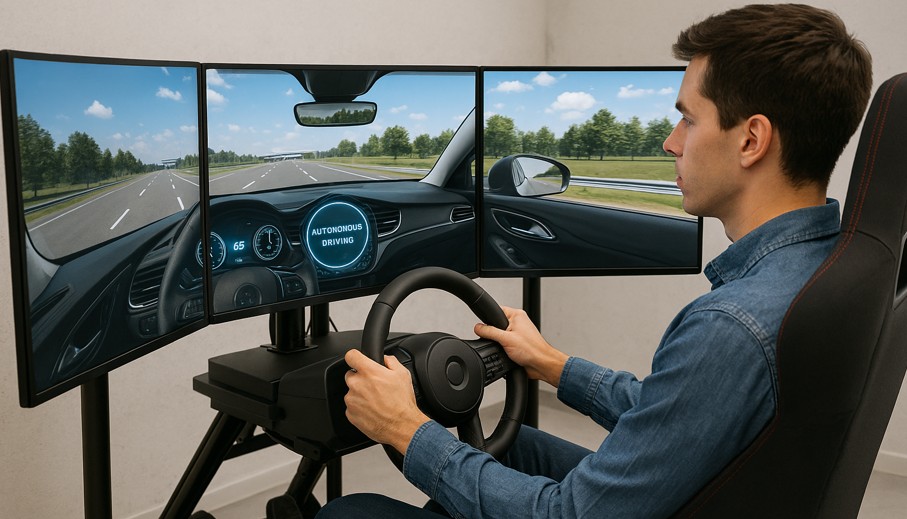
Loughborough University Driving Visulaliser
View from Driving Visualiser in Human Factor Lab at Loughborough University
Data Analysis and Results
Statistical differences between TOR for participants performing NDRTs and participants not performing NDRTs was assessed using SPSS software. The mean scores and standard deviations for TOR were calculated and compared for both conditions using suitable statistical analysis methods such as the Wilcoxon signed-rank test which is used to compare the two conditions taken from within one group when the data does not meet the normality assumption of the paired t-test as in this study. Statistical significance was set at p < 0.05.
To visualise the data from the different conditions, bar charts and histograms were selected based on the specific data being presented.
Histogram – TOR whilst performing NDRT
Participants had a mean TOR of 5.54 seconds when performing NDRTs in comparison to a mean TOR of 3.71 when not performing any task. This approximately 1.83 seconds average difference between the two conditions meant that participants taking longer to be ready to drive would also not be ready to avoid any potential hazards during this time. In this example the car was traveling at around 30 miles per hour on a Nottingham City road which means that in the 1.83 seconds, that is the key difference, participants would travel around 24 meters (80 yards) extra without control of the vehicle. That distance is equivalent to just over the length of two standard London City buses parked back to front. This extra distance and time taken to regain control could lead to catastrophic consequences.
Histogram – TOR with no task
Conclusion
Upon conclusion of this project it was noted that on average, participants performing NDRTs whilst in autonomous vehicles have less capability in terms of reaction time when presented with a potential hazard and also decreased SA which may contribute to the slower reaction times presented in this study. The need for clear and more defined time frames for takeovers, information on what specifically constitutes a ‘safe and effect takeover’ and the potential for improved systems to help drivers gain a higher level of SA have been highlighted in this study. Future research that would be of interest may also look at how TOR or disengagement specifically are effected when the NDRT is integrated on the car’s infotainment system.
OTHER PROJECTS
Service Evaluation for Inclusive Design
Carried out a study to assess the McDonalds Drive-thru service and its suitability with respect to disabled users, most notably those with colourblindess. A proxy user was created using a persona and methods such as the use of customer journey maps, stakeholder maps, and service safaris with the inclusion of empathetic modelling were used to understand the service from the user perspective and gain appreciation for pain-points, touch-points and backstage process of the service.
Role of Human Factors Accidents via Systems Analysis
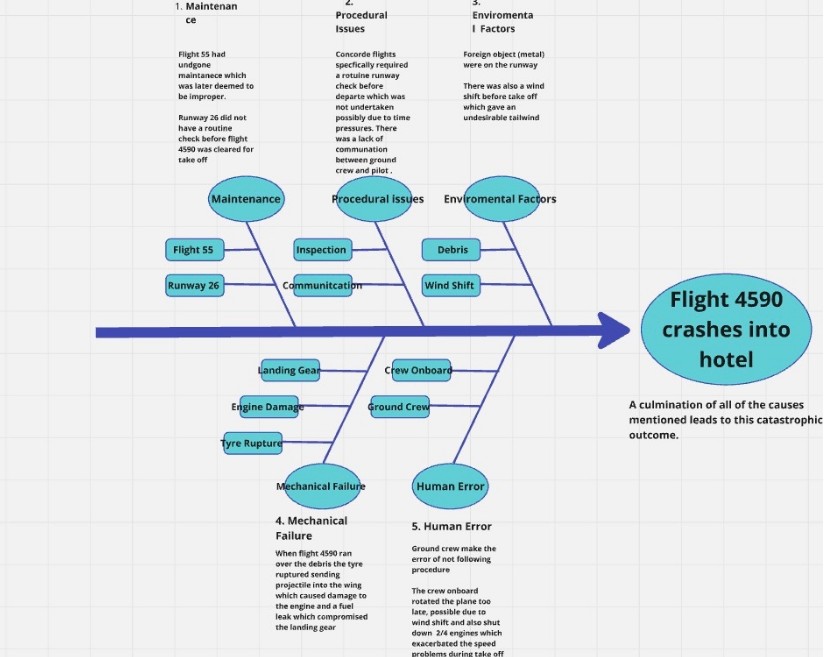
Developed a keen interest in understanding the role of human factors in accidents, especially in aviation. As part of coursework, a systems analysis of human factor issues that contributed to the Air France Flight 4590 crash (2000) was undertaken using methods such as fish bone diagrams, Swiss cheese model and Accimaps.
Cognitive Ergonomics of Formula 1 Driver
Research into the cognitive human factors that go into enhancing the performance of elite athletes, in this case, Formula 1 drivers. Key aspects of this research included: workload, processes, human-computer interaction, situational awareness, decision-making, memory, attention and training. These mental processes all influence human interaction with systems and environments with the ultimate aim of optimising usability to enhance performance and increase safety.