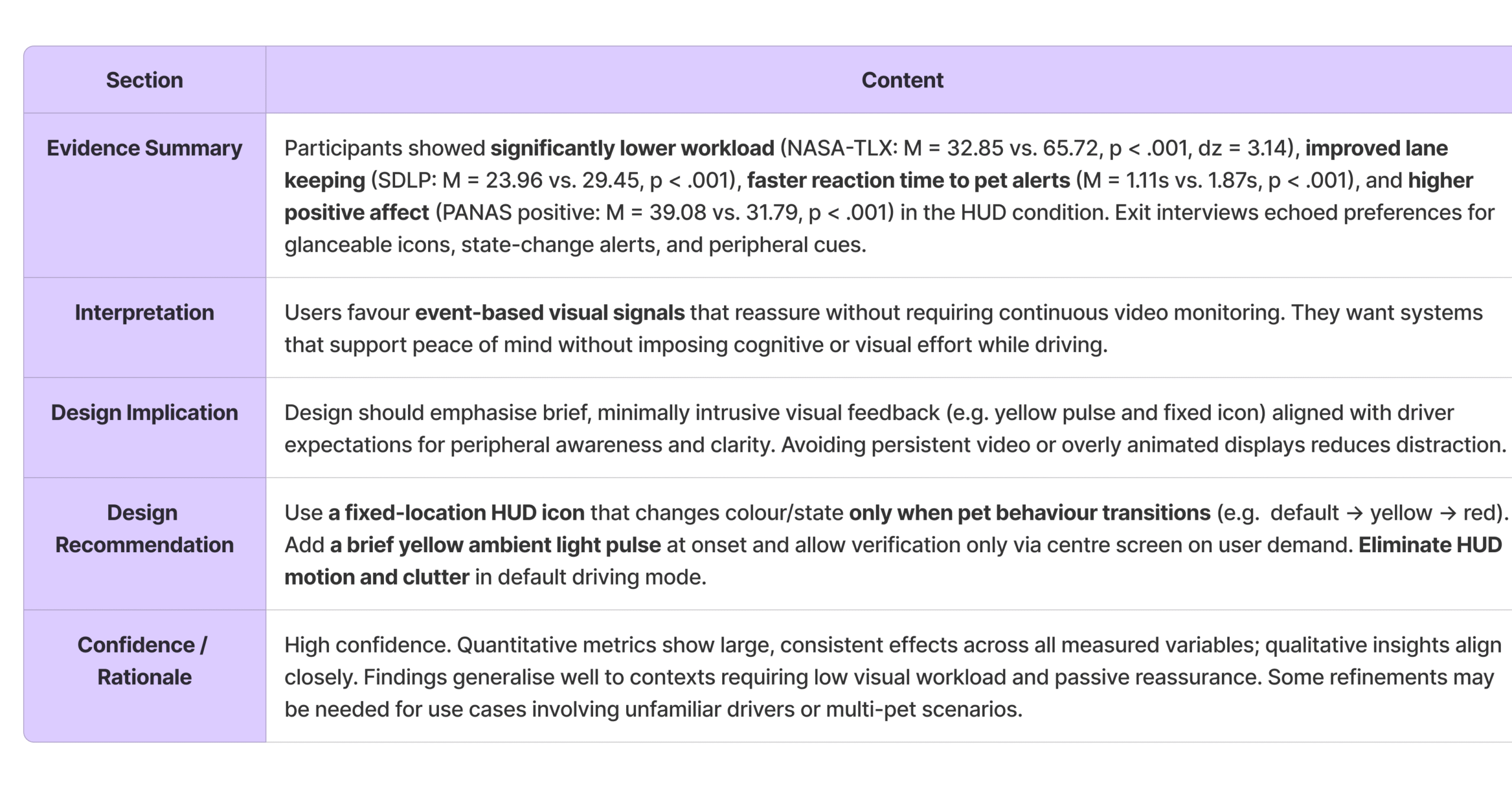
I am a UX designer who values creativity and curiosity, always exploring solving real-world problems with emerging technologies. Life is brighter with my dog by my side and a future goal in product management.
I am a UX designer who values creativity and curiosity, always exploring solving real-world problems with emerging technologies. Life is brighter with my dog by my side and a future goal in product management.

Many drivers travel with pets, yet a large proportion do not restrain them properly Unrestrained pets are exposed to stress and pose safety risks during sudden braking or accidents.
For drivers, frequent pet movement can cause visual and manual distraction every 7–8 seconds.(Hazel et al., 2019)

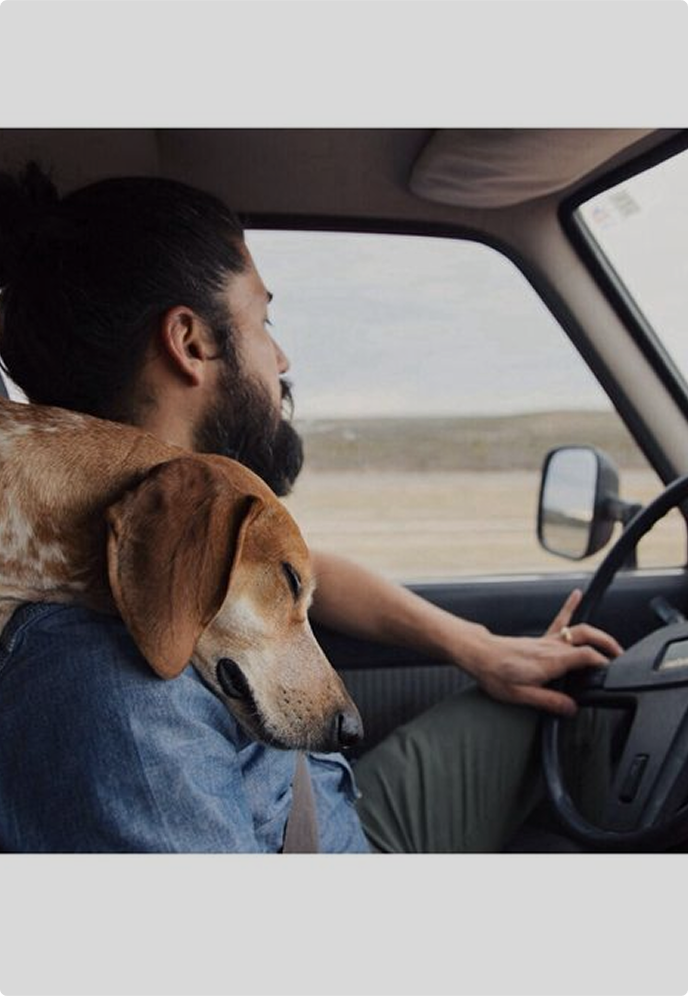
The aim is to design and empirically evaluate an in-vehicle pet monitoring interface that supports driver reassurance with minimal distraction, focusing on a HUD modality compared against a centre-screen baseline.
Where I Started
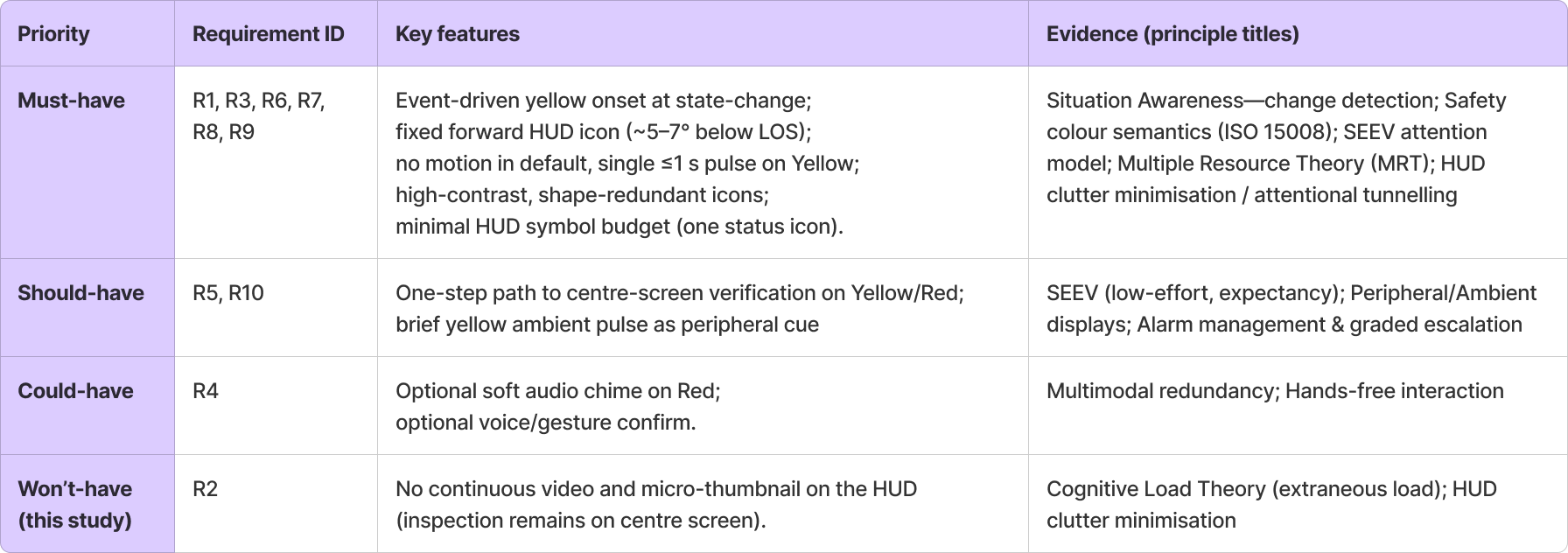
I interviewed five pet-owning drivers and heard the same message four ways: tell me only when the pet’s state changes; yellow before red; let me know without looking away; keep it simple and predictable. I translated this into MoSCoW requirements and a minimal, event-driven HUD policy.
My Design Principles
Multiple Resource Theory and the SEEV attention model pushed me to keep cues in the forward field, limit search effort, and avoid visual clutter. I aligned colours to safety semantics (default = normal, yellow = abnormal) and used shape + colour redundancy for accessibility.
Design Iteration
I started with paper sketches and Figma wires to test iconography and colour mapping, then moved to clickable screens and a driving-sim rig. A pilot exposed two issues: too many accent colours were distracting, and OBS overlays stuttered the simulator. I therefore kept only yellow as the caution colour and mocked the HUD with a phone screen mounted at the lower-left forward field (smooth, reliable timing). I also shortened each drive from 5 to 3 minutes to limit fatigue while keeping two pet events per run.
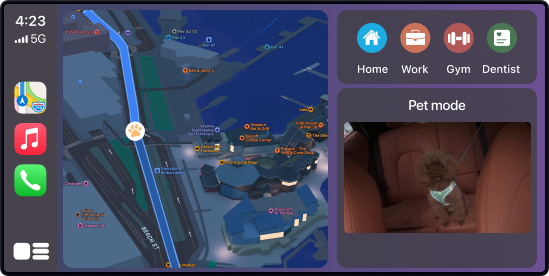
Centre screen (P-C) – An industry-typical baseline with persistent rear-seat video (CarPlay-inspired layout), where reassurance zlargely depends on head-down glances.
HUD (P-H) – A fixed-locus paw icon ~5–7° below the sight line.
• Normal: static grey.
• State change: turns yellow with a ≤1 s one-shot pulse + a brief yellow ambient band (peripheral cue).
• No continuous video on the HUD; if I want to verify, I glance to the centre screen.

A within-subjects, counterbalanced study was run in City Car Driving (Game) with 24 licensed drivers (where the number of participants were determined using G*Power tool) (3-minute scenarios; two pet state changes per condition). I reported descriptives, checked normality on paired differences (Shapiro–Wilk), and used paired t-tests (α = .05).


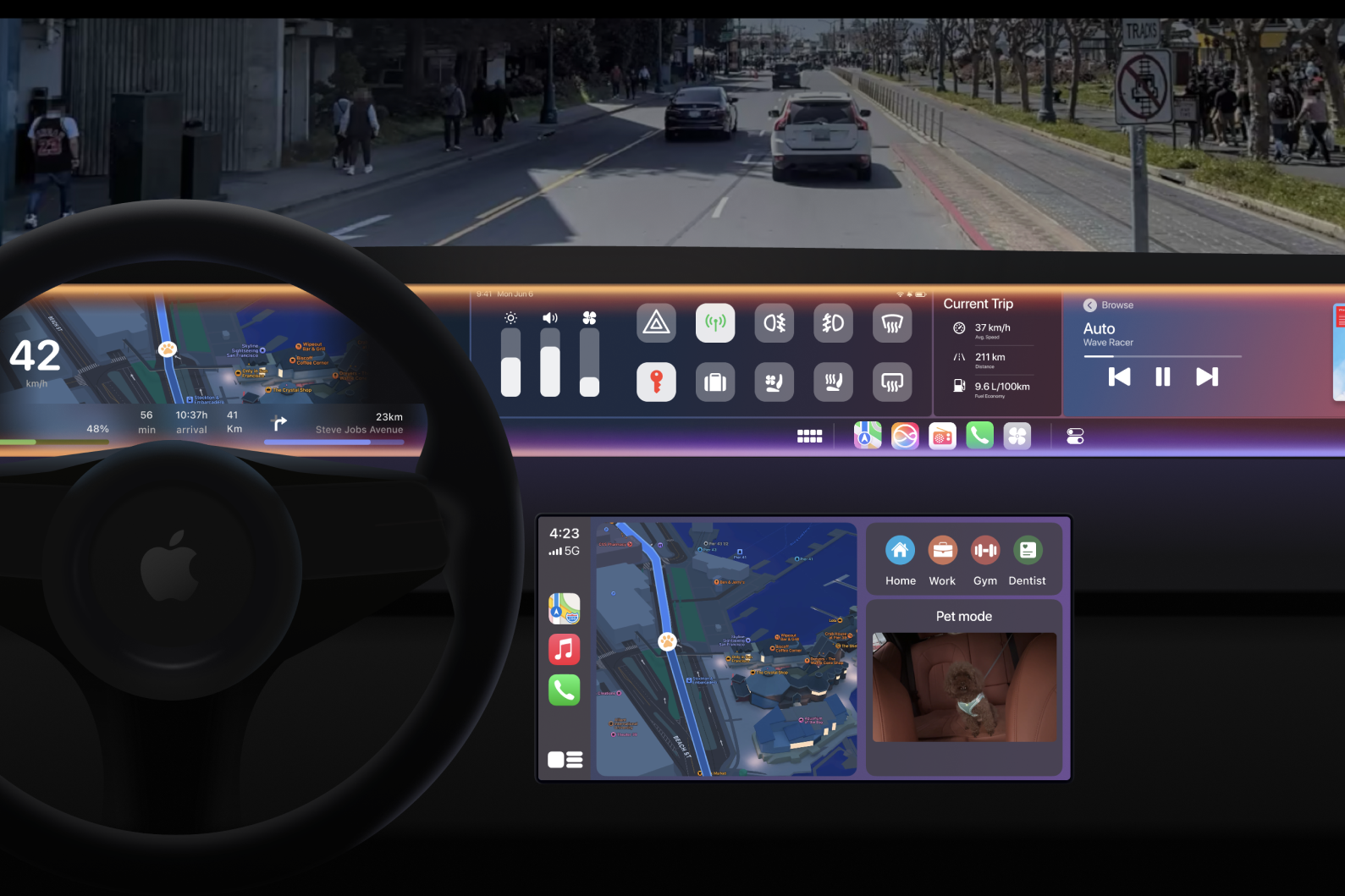
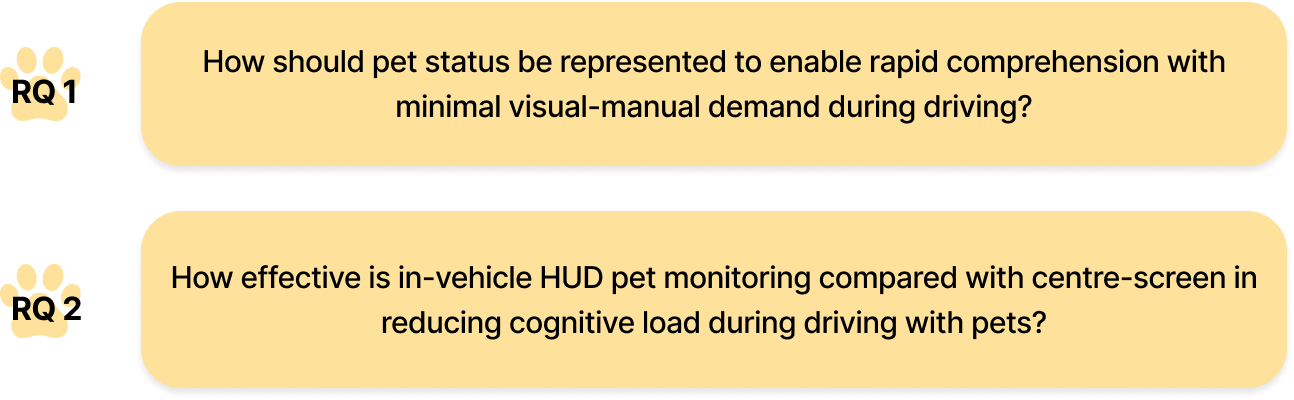
RQ1 — How should pet status be represented for rapid comprehension with minimal visual–manual demand?
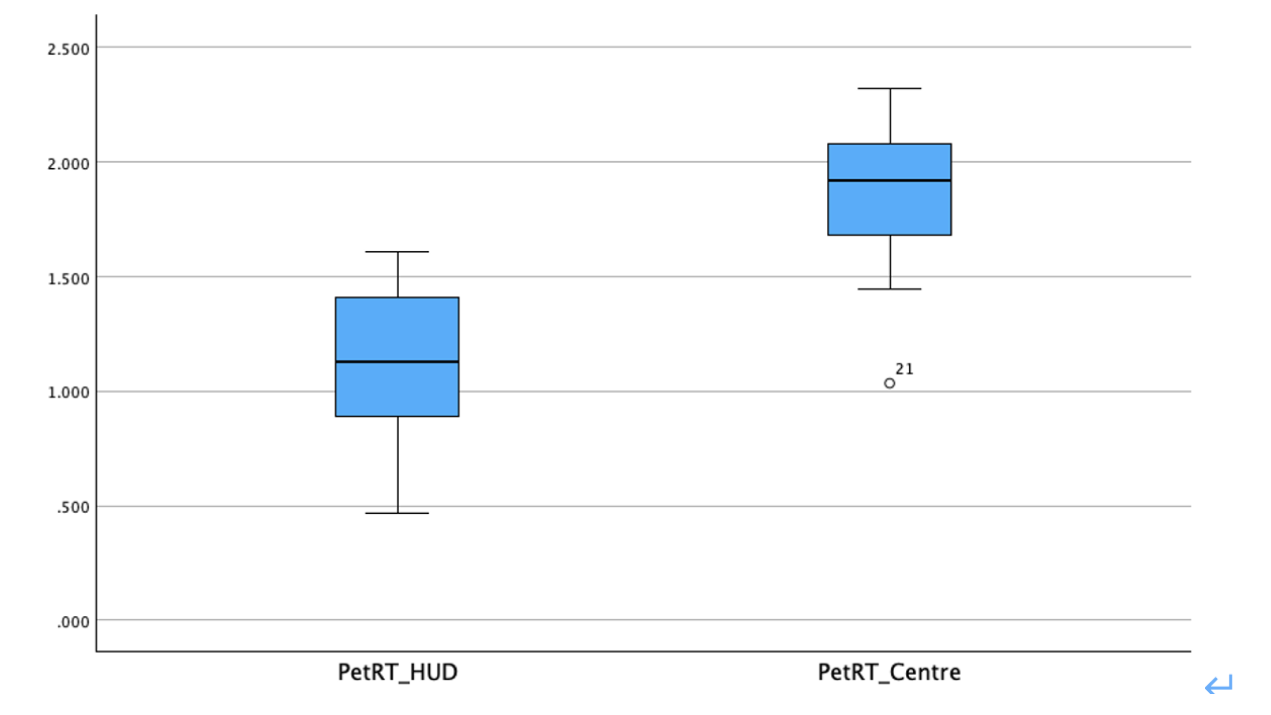
A large improvement was seen in Pet reaction time—HUD 1.11 seconds versus 1.87 on the centre screen; the paired test shows an extremely large effect. On UEQ-S Overall the HUD also scores higher—2.07 versus 0.86. The boxplots show both better medians and tighter spread for the HUD. Qualitatively, participants said they could ‘know without searching’—the one-shot yellow onset at a predictable forward place let them register change without looking down.

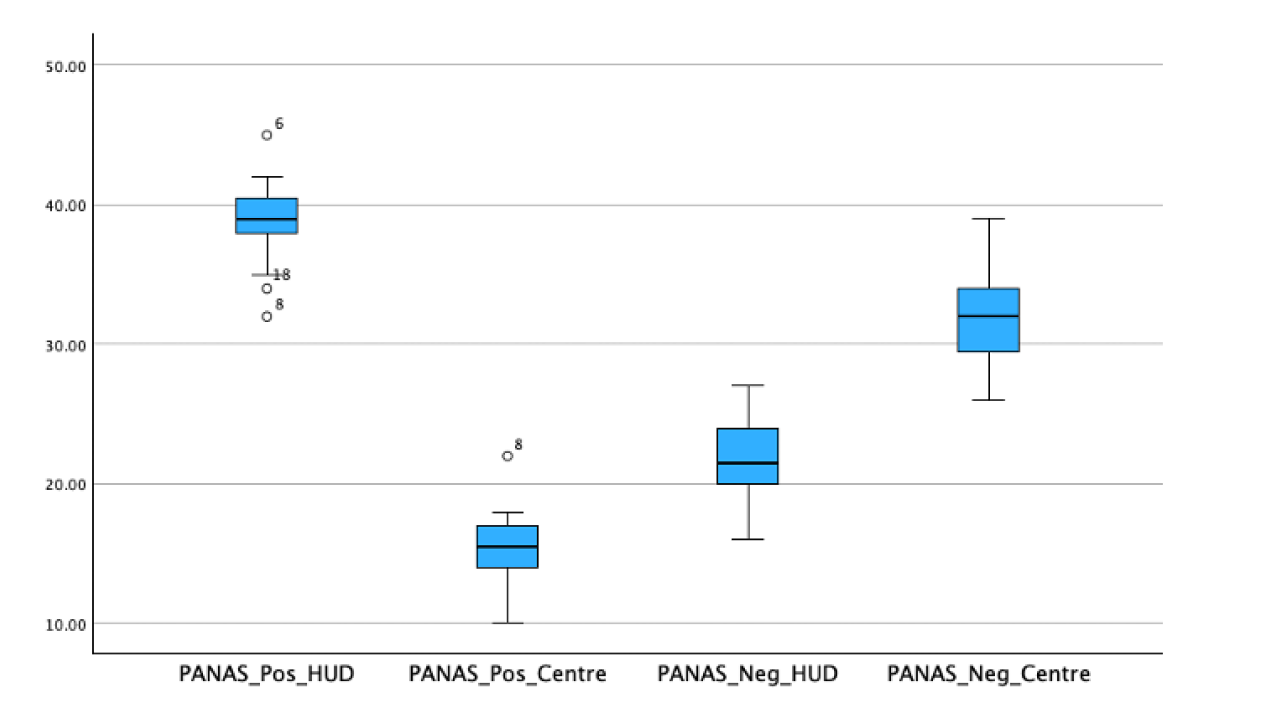
RQ2 —How effective is in-vehicle HUD pet monitoring compared with centre-screen in reducing cognitive load during driving with pets?
Here I look at control smoothness and emotions. Speed variance is significantly lower with the HUD—3.35 versus 5.37 km/h, t(23) = –8.79, p < .001, dz = 1.80—indicating more stable throttle control. On PANAS, positive affect increases (39.08 vs 31.79) and negative affect decreases (15.38 vs 21.58), both p < .001 with large effects. In short, the event-triggered HUD not only reduces checking pressure but also makes drivers feel calmer and more reassured.”

Finally, the core safety proxies. Lane keeping improves: SDLP drops from 29.45 px to 23.96 px, t(23) = –8.22, p < .001, dz = 1.68. And weighted NASA-TLX halves, from 65.72 to 32.85, t(23) = –15.40, p < .001, dz = 3.14—a huge reduction in perceived workload. Participants summarised it well: ‘Video is for confirming, not for driving.’ The HUD’s change-based cue gives reassurance at a glance, while persistent centre-screen video pulls eyes off the road.”


The HUD bundles two favourable factors—a fixed, near-road icon and a one-shot yellow ambient pulse as a redundant peripheral cue. This “predictable location + high salience” combination likely boosted detectability, partly explaining the very large effects (consistent with attention-allocation theory). This doesn’t mean every HUD will perform equally; follow-up factorial studies should isolate icon vs ambient, luminance/size, and placement.