yuehua-li profile photo

As an open-minded and adaptable designer, I translate user needs into innovative product solutions. My experience at Loughborough has strengthened my passion for design research, prototyping, and manufacturing strategies, enabling me to embrace new perspectives and drive meaningful, user-centered innovation.

Optimization and Modification of Pet Grooming Products

This project addresses the inefficiencies and inconveniences of traditional pet grooming tools, which are often bulky and require frequent switching between devices. Through user research, it became clear that both home users and professionals need lightweight and easy-to-store solutions that adapt to different grooming tasks. My design introduces a modular system with a main body and interchangeable attachments for brushing, trimming, grinding, and vacuuming. Prototyping and user testing guided the development of an ergonomic, dual-ended form and a quick magnetic-mechanical connection, enabling secure and intuitive module switching in under five seconds. The final outcome enhances grooming efficiency, reduces equipment redundancy, and offers a compact, user-friendly solution with clear commercial potential.

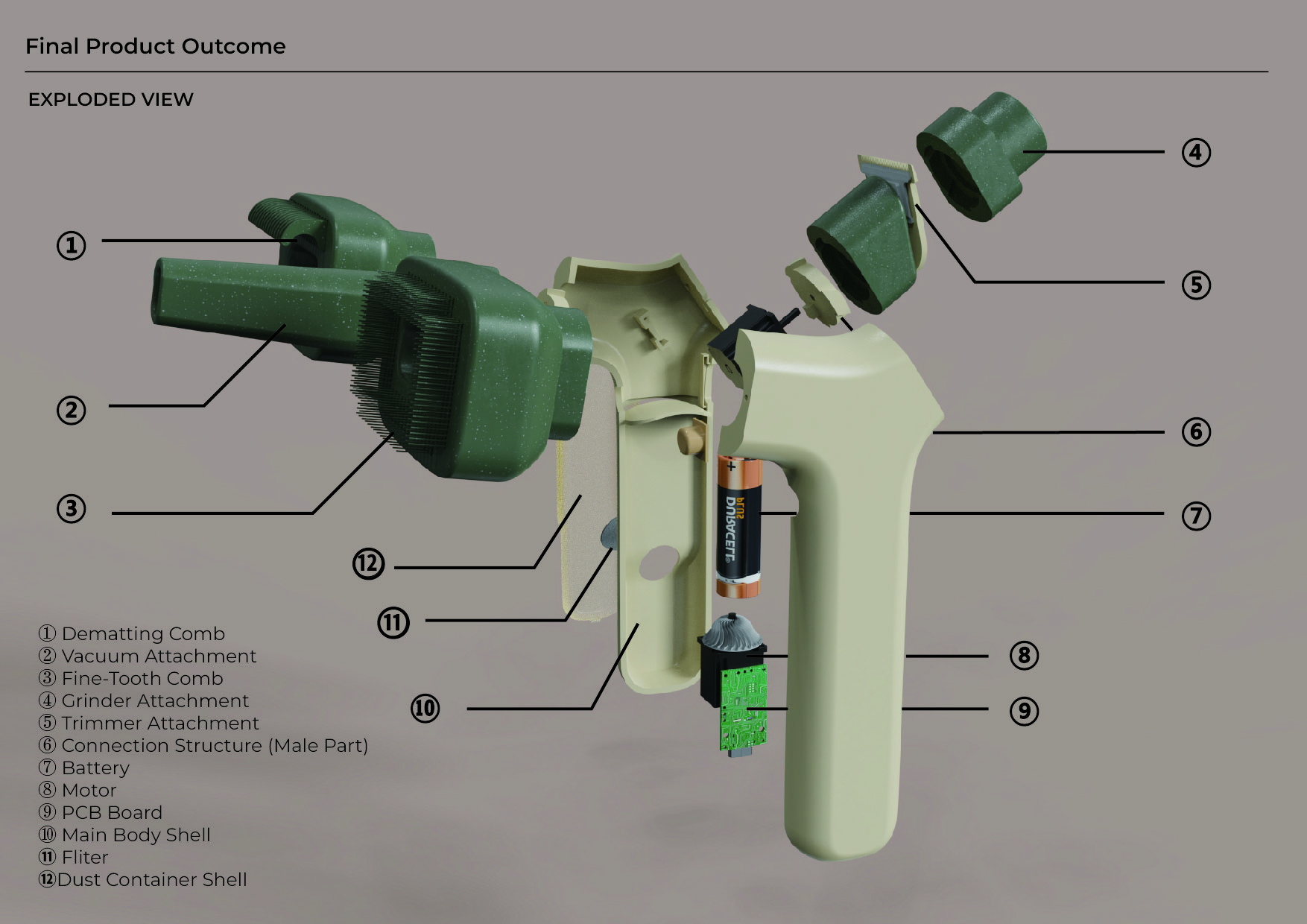
This modular pet grooming tool combines a main body with five interchangeable attachments, offering an efficient and space-saving solution for both home and professional use. The system includes a vacuum that collects loose hair directly into a dust container, a dematting comb that gently removes tangles, a fine-tooth comb for daily de-shedding, a trimmer for precise grooming around sensitive areas, and a grinder for safe nail care. With its ergonomic dual-ended handle and magnetic-mechanical connection, attachments can be switched in under five seconds, ensuring smooth transitions between tasks. Designed for comfort and compact storage, the product enhances the grooming experience for both pets and their owners.

Prototyping Process

The prototyping process includes three stages: Lo-Fi, Mid-Fi, and High-Fi.

Lo-Fi Prototype

After the sketch phase of form exploration, five concepts were selected based on their overall aesthetics and proportional harmony for further development. In the Lo-Fi prototyping stage, 2D sectional models were created using cardboard to enable quick and low-cost testing. These prototypes served to evaluate the visual volume, proportion, and initial ergonomic impression of the different form options, providing a foundation for subsequent iterations with higher-fidelity models.

Mid-Fi Prototype

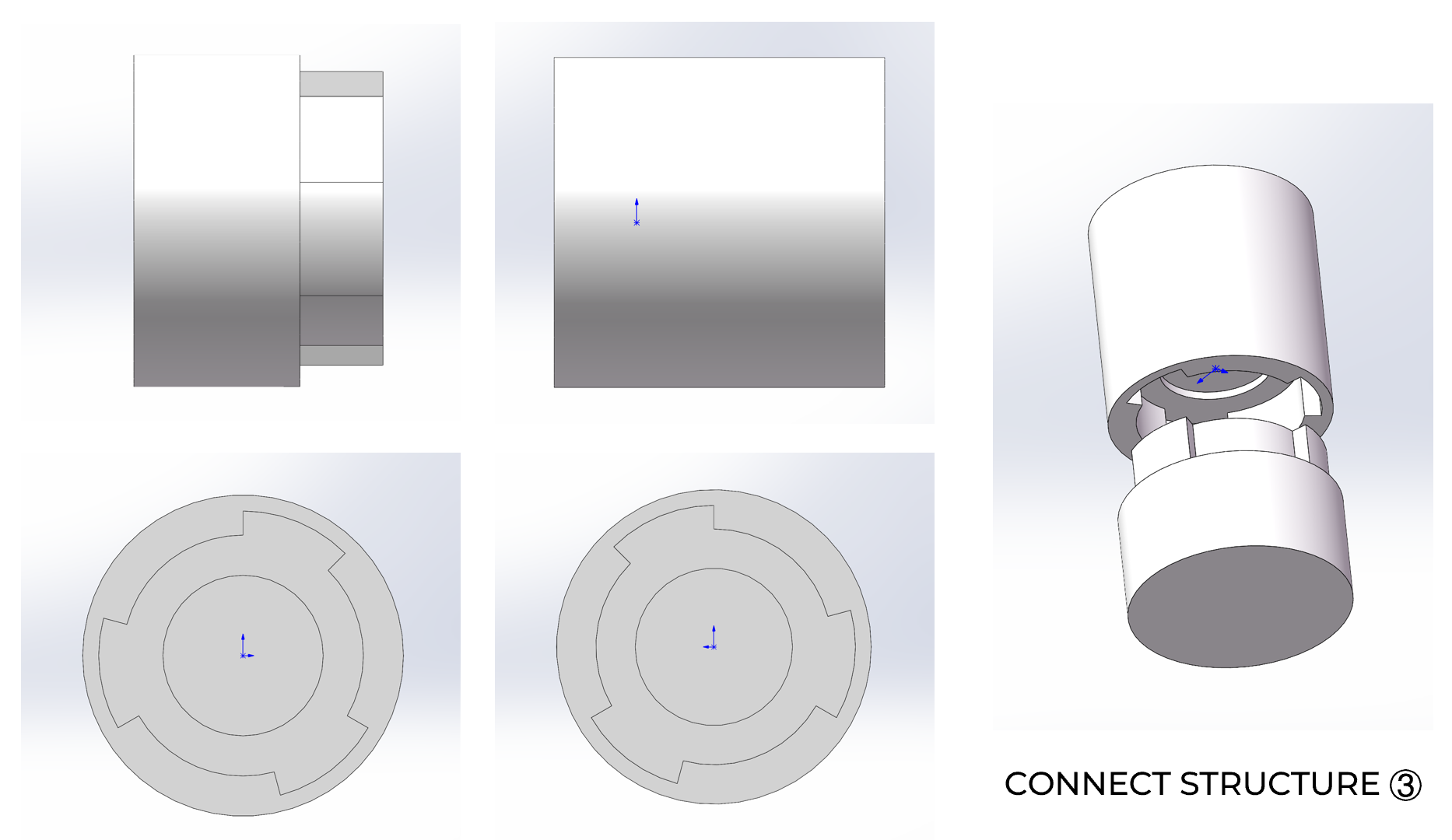
In the Mid-Fi stage, the selected Lo-Fi concepts were developed into 3D models and 3D-printed to validate ergonomics, proportions, and grip comfort in more realistic conditions. This stage also focused on testing the modular connection structures, where different magnetic and snap-fit mechanisms were prototyped to evaluate stability, ease of use, and durability. The process provided clearer feedback on handling, switching performance, and overall usability, forming the foundation for refinement in the Hi-Fi prototype stage.

High-Fi Prototype

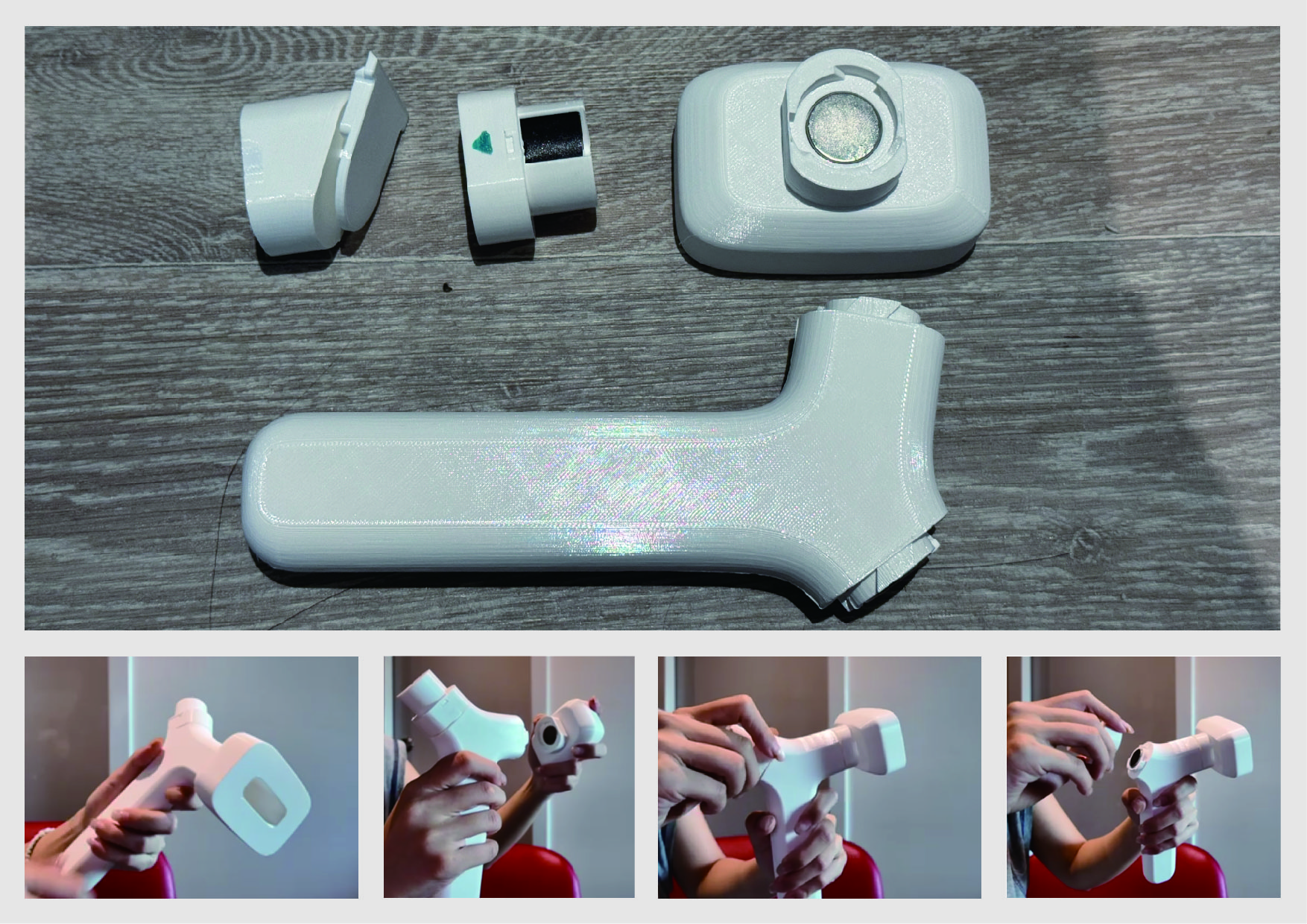
At the Hi-Fi stage, the prototype was refined based on feedback from the Mid-Fi tests. A complete 3D-printed model, including the main body, connection structures, and attachments, was produced. This allowed testing in near-real usage conditions, focusing on ergonomic comfort, attachment switching, and overall usability.