I am a UX designer with a background in educational technology, passionate about creating intuitive and research-informed learning experiences. My work bridges interaction design and pedagogy, focusing on accessibility, engagement, and evidence-based digital solutions that support diverse learners.
Exploring VR for Education: Spatial Learning
This project is a visual-spatial learning experience designed in VR. It explores how task complexity and VR interactivity individually and together, affect learners’ cognitive load and performance. The findings inspire UX designers and educators to balance design elements in future visual-spatial learning experiences.
The Context
While visual-spatial reasoning is a critical skill used in areas like education, engineering and professional training, lots of leaners find it difficult to mentally transform the shapes, or think about how features combine. VR is becoming widely used to enhance spatial reasoning as it can provide immersive experience that allows direct interaction. In the literature, task complexity and how much users can interact are seen as the main factors that change the learning experience, and most studies look at cognitive load and learning performance as the main things to measure.
“I’ve always found it hard to understand shapes. In class, whether the teacher shows a 3D shape on the whiteboard or the screen, I find it really hard to picture what the back looks like. Even with the explanation, I still struggle to imagine it.”
– Annie Li (first-year undergraduate)
Existing Findings
VR facilitates spatial Learning
Performance better in VR than other non-VR approaches
Task Complexity increases Cognitive Load
More elements & relationships create more mental effort
Many studies show VR helps spatial learning compared with non-VR, but those comparisons do not tell us which design factors inside VR actually matter. Second, task complexity clearly raises cognitive load because more elements and relationships demand more mental effort, but its impact on learning performance remains unclear. Third, interactivity has mixed effects: it can support presence and learning but too much interaction can confuse or exhaust learners. Importantly, complexity and interactivity are usually studied separately, so we do not know how they interact.
Research Questions
RQ1
How does different task complexity affect cognitive load and learning performance in a VR-based spatial learning environment?
RQ2
How does different levels of VR interactivity impact cognitive load and learning performance in a VR-based spatial learning environment?
RQ3
How do task complexity and interactivity level interactively affect learners’ cognitive load and learning performance?
Prototype Development
The prototype development of this study follows a formative assessment approach.
Shapes were modelled in Fusion360 across two different levels of complexity with reference to literatures. Several rounds of formative assessment with learners was used to validate perceived complexity using a modified NASA-TLX, collect the time they spent on object identification, and some feedback of the whole experiences. Feedback showed some shapes were too easy or too confusing and learners spent effort on thinking about controls rather than analysing object features. Based on those results, phase durations were set from the formative data, objects were selected and modified, a short tutorial was added, guidance was updated with images, and prototype bugs were fixed.
Early concept sketches
A pilot learner doing formative assessment
Modified NASA-TLX for formative mental effort collection
Learning Environment Settings
The learning environment was designed as a minimal VR room with neutral walls and simple lighting to avoid distracting cues. A short tutorial and on-screen guidance are provided to reduce unnecessary effort.
Levels of VR Interactivity
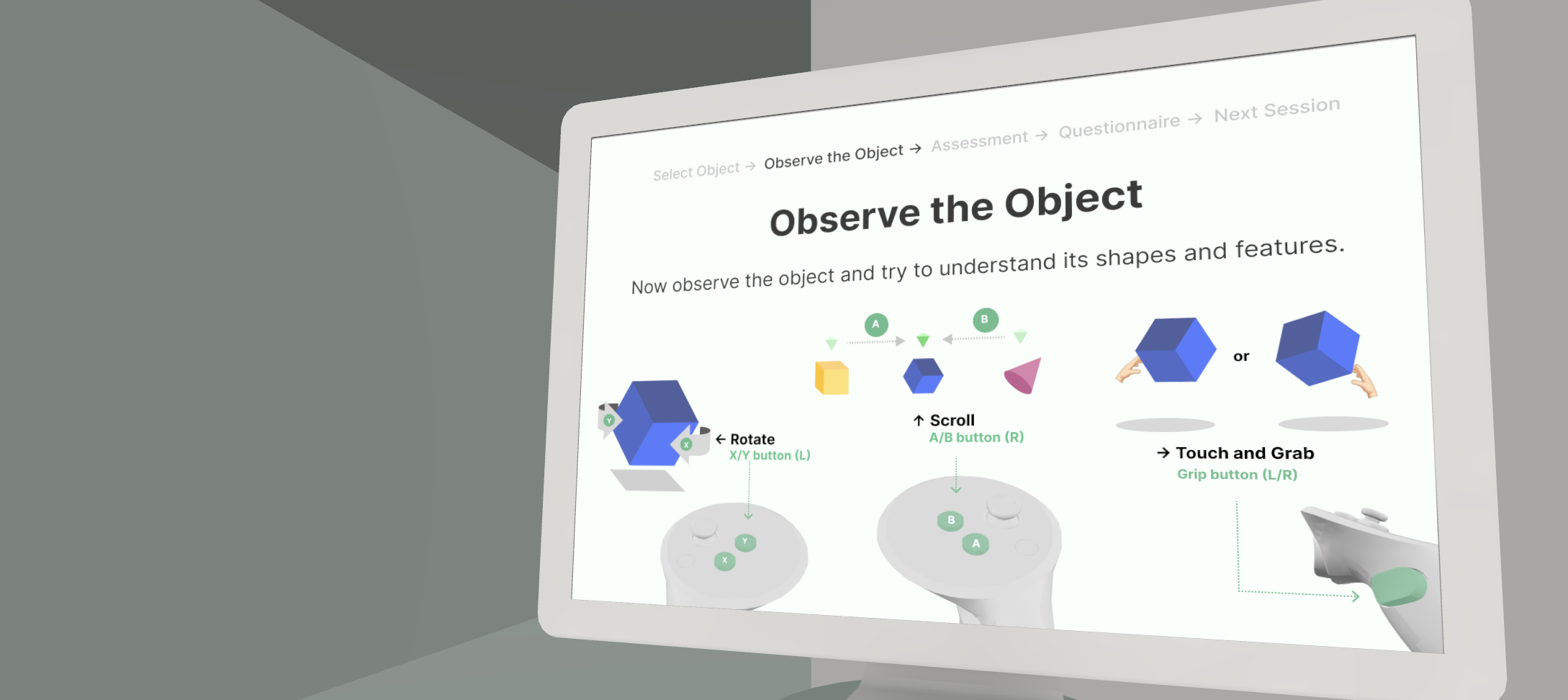
The study uses two interactivity levels. Low interaction means seated viewing with restricted movement. High interaction allows free rotation and grab-in-hand observation.
Low Interactivity – Fixed view observation
High Interactivity – 360 degree rotation
High Interactivity – Grab-in-hand examination
Learner’s behaviour at two levels of interactivity
Seated viewing, restricted body movement
Free rotation & grab-in-hand examination
Levels of Task Complexity
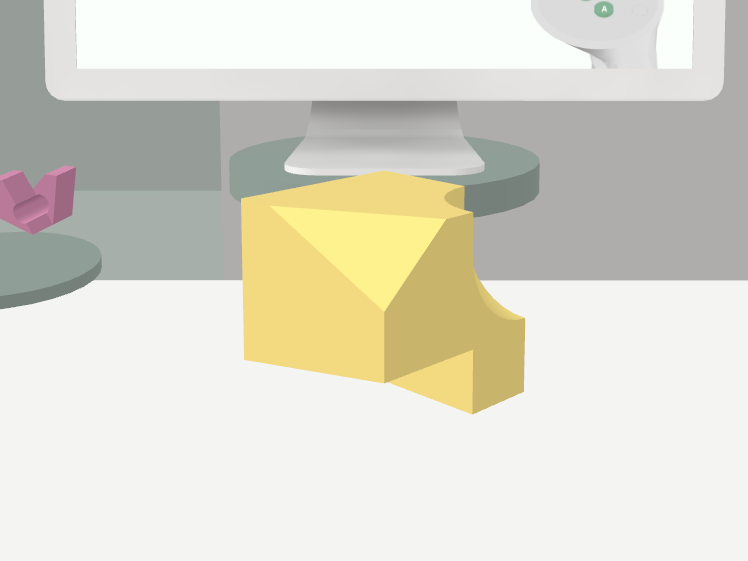
Task complexity is split into low and high. 12 objects were created across 4 conditions. Low items have simple edges and few cuts. High items have irregular edges, interlocking features and more cuts.
Task Flow
Starting with an on-boarding tutorial, participants follow a pre-set order to experience a total of four prototypes. Their mental effort was collected after experiencing each prototype, and the overall learning experience feedback was captured during a short exit interview.
Assessment Phase Design
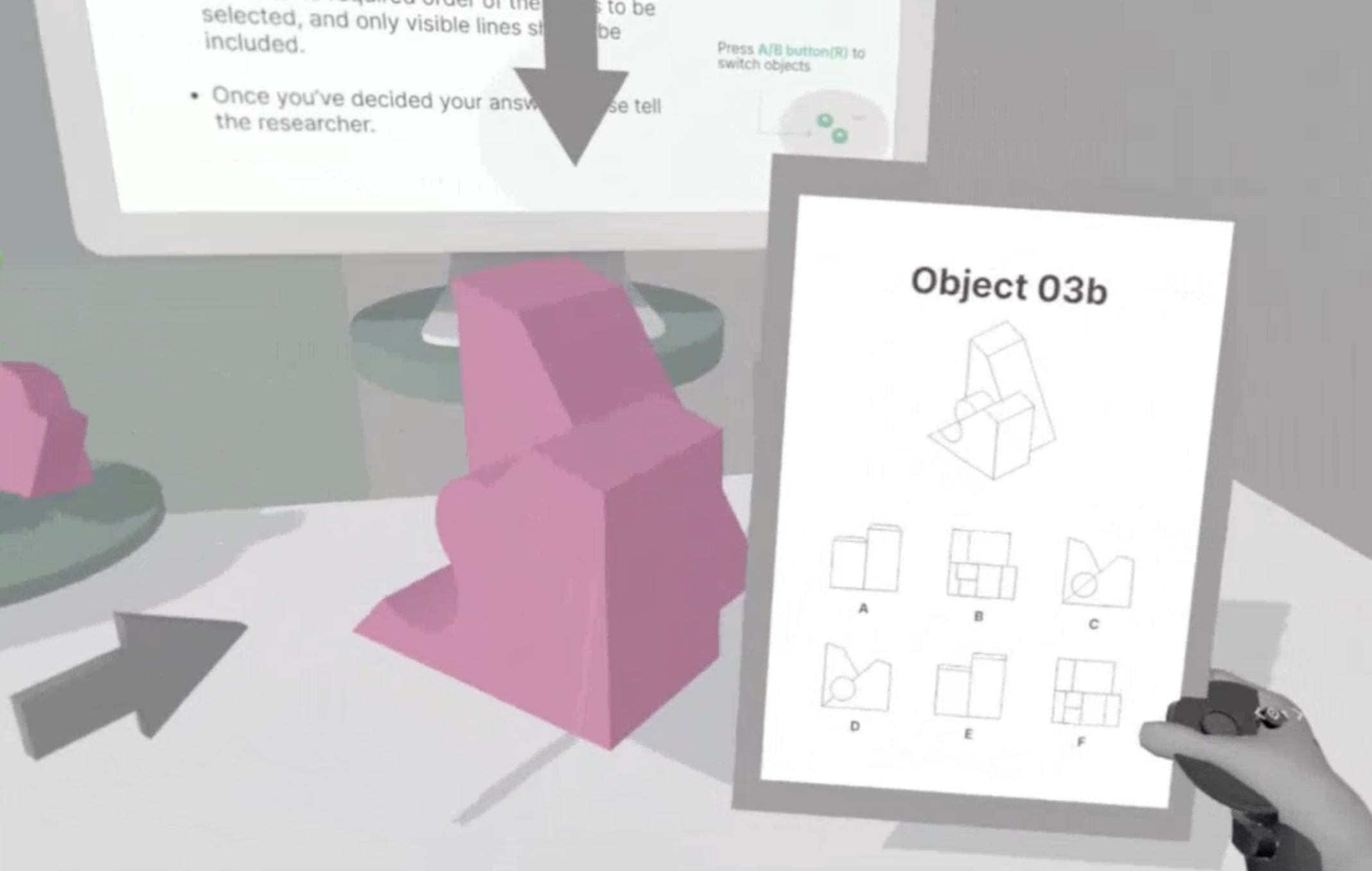
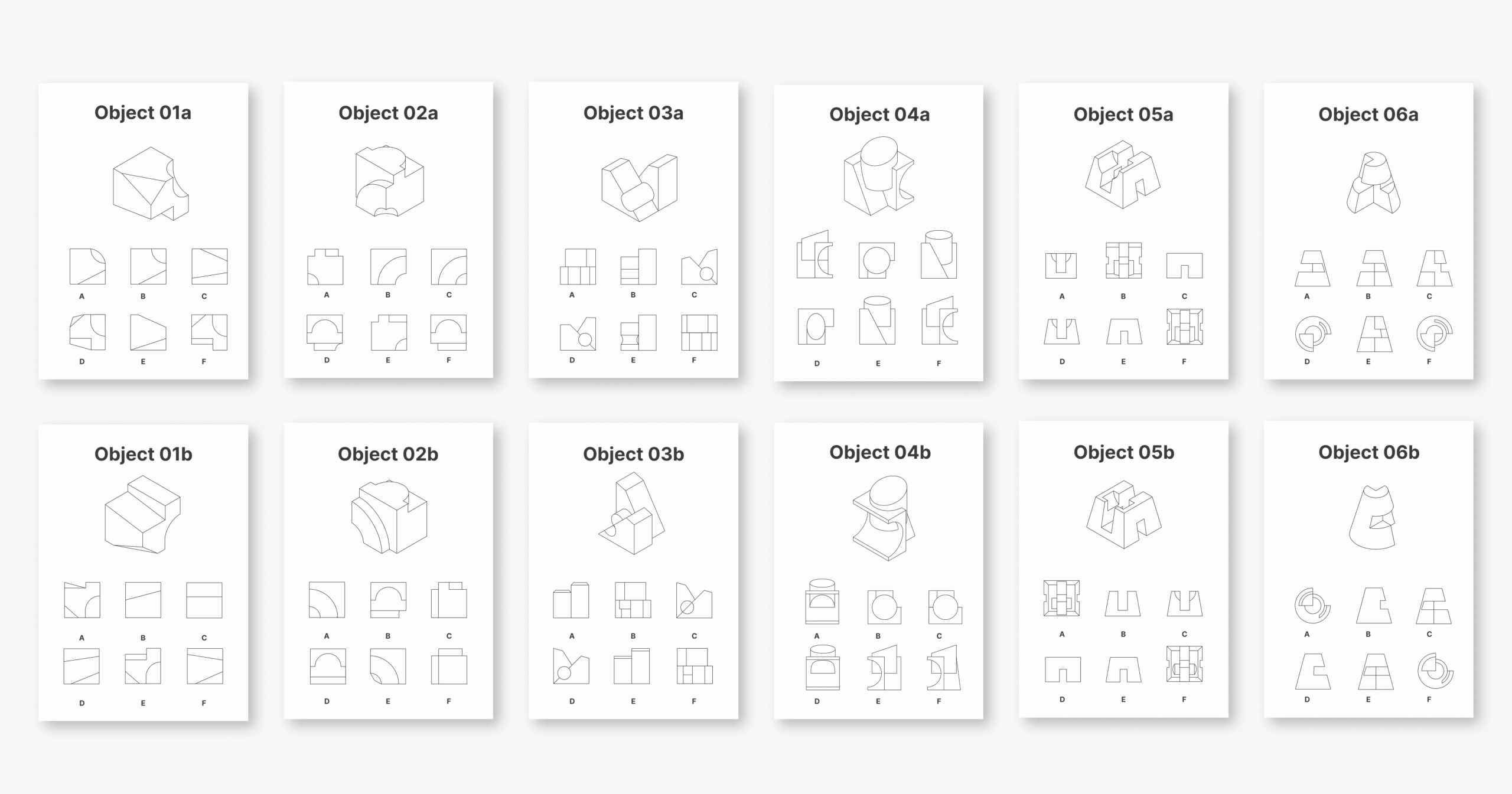
Each question paper shows one isometric view of the object and six orthographic choices for the participant to pick from.
Learner looking at the question paper
Question papers of all objects
What Participants Said…
Being able to directly rotate to the correct view helped me see the sections clearly without guessing.
– Participant 06
Definitely, being able to hold it was better. When I could hold it, I could place it at a relatively level angle. When viewed from a fixed position, parts that seemed in the same plane might actually have height differences. Moving it allowed me to adjust it to a flat angle on purpose, making judgment easier.
– Participant 04
…not much impact. Even if I looked at it a hundred times, I still couldn’t remember it. It felt like, no matter how many times I looked, I was still relying on my intuition.
-Participant 02
Key Findings and Future Opportunities
Higher task complexity consistently increased cognitive load, and it only reduced learning performance in the high interactivity condition.
Interactivity reduced mental demand for high complexity tasks but had little effect for low complexity tasks. No clear effect of interactivity on learning performance was found.
The benefit of interactivity depends on task complexity. High interactivity can cut extraneous load, but when intrinsic load is already high it may still overwhelm learners and so not improve performance.
Design Recommendations
Match interactivity to task demand
Avoid maximising interactivity; instead, scale it to task complexity to reduce cognitive load without causing over-engagement.
Reduce off-task distraction
Restrict unnecessary manipulations so learners focus on spatial reasoning rather than handling controls.
Manage environmental factors
Use clear contrast, lighting, and colours to make key spatial features more distinguishable and reduce confusion.
Future Research
Test intermediate levels
Explore multiple levels of task complexity and interactivity to capture non-linear effects and thresholds.
Increase methodological precision
Use larger sample sizes and parametric models; refine manipulation (e.g., fixed angular increments for object rotation).
Investigate environmental elements
Examine how colour, lighting, and audio cues interact with task design factors to influence cognitive load and learning.